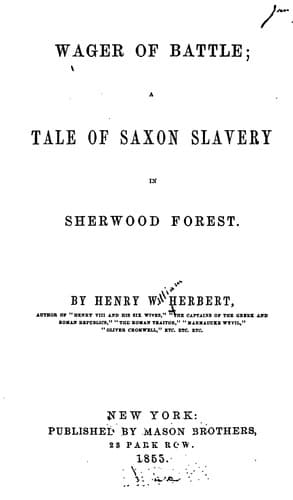
Wager of Battle: A Tale of Saxon Slavery in Sherwood Forest — John Shaqi
Wager of Battle: A Tale of Saxon Slavery in Sherwood ForestHerbert, Henry William
History
Wager of Battle: A Tale of Saxon Slavery in Sherwood Forest
Herbert, Henry William
Anglo-Saxons -- Fiction; Great Britain -- History -- Norman period, 1066-1154 -- Fiction; Sherwood Forest (England) -- Fiction
In the latter part of the twelfth century--when, in the reign of Henry
II., fourth successor of the Conqueror, and grandson of the first
prince of that name, known as Beauclerc, the condition of the
vanquished Saxons had begun in some sort to amend, though no fusion of
the races had as yet commenced, and tranquillity was partially
restored to England--the greater part of the northern counties, from
the Trent to the mouths of Tyne and Solway, was little better than an
unbroken chase or forest, with the exception of the fiefs of a few
great barons, or the territories of a few cities and free borough
towns; and thence, northward to the Scottish frontier, all was a rude
and pathless desert of morasses, moors, and mountains, untrodden save
by the foot of the persecuted Saxon outlaw.
In the West and North Ridings of the great and important Shire of
York, there were, it is true, already a few towns of more than growing
importance; several of which had been originally the sites, or had
grown up in the vicinity and under the shelter of Roman Stative
encampments; whereof not a few of them have retained the evidence in
their common termination, _caster_, while others yet retain the
more modern Saxon appellations. Of these two classes, Doncaster,
Pontefract, Rotherham, Sheffield, Ripon, may be taken as examples,
which were even then flourishing, and, for the times, even opulent
manufacturing boroughs, while the vastly larger and more wealthy
commercial places, which have since sprung up, mushroom-like, around
them, had then neither hearths nor homes, names nor existence.
In addition to these, many great lords and powerful barons already
possessed vast demesnes and manors, and had erected almost royal
fortalices, the venerable ruins of which still bear evidence to the
power and the martial spirit of the Norman lords of England; and even
more majestic and more richly endowed institutions of the church, such
as Fountains, Jorvaulx, and Bolton Abbayes, still the wonder and
reproach of modern architecture, and the admiration of modern artists,
had created around themselves garden-like oases among the green glades
and grassy aisles of the immemorial British forests; while, emulating
the example of their feudal or clerical superiors, many a military
tenant, many a gray-frocked friar, had reared his tower of strength,
or built his lonely cell, upon some moat-surrounded mount, or in some
bosky dingle of the wood.
Public-domain text, read in full here on John Shaqi.
Reviews
Reviews
No reviews yet
Be the first to share your thoughts on this work.
Join the Discussion
Join the discussion
Sign in to leave a comment or review.
Sign InorCreate an account