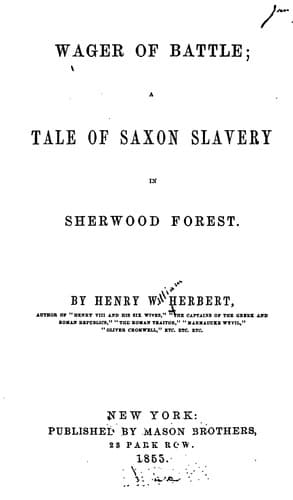
Wager of Battle: A Tale of Saxon Slavery in Sherwood ForestHerbert, Henry William
History
Wager of Battle: A Tale of Saxon Slavery in Sherwood Forest
Herbert, Henry William
Anglo-Saxons -- Fiction; Great Britain -- History -- Norman period, 1066-1154 -- Fiction; Sherwood Forest (England) -- Fiction
In the East Riding, all to the north of the ancient city of the Shire,
even then famous for its minster and its castle, even then the see and
palace of the second archbishop of the realm, was wilder yet, ruder
and more uncivilized. Even to this day, it is, comparatively speaking,
a bleak and barren region, overswept by the cold gusts from the German
ocean, abounding more in dark and stormy wolds than in the cheerful
green of copse or wildwood, rejoicing little in pasture, less in
tillage, and boasting of nothing superior to the dull market towns of
the interior, and the small fishing villages nested among the crags of
its iron coast.
Most pitilessly had this district been ravaged by the Conqueror and
his immediate successor, after its first desperate and protracted
resistance to the arms of the Norman; after the Saxon hope of England
fell, to arise no more, upon the bloody field of Hastings; and after
each one of the fierce Northern risings.
The people were of the hard, old, stubborn, Danish stock, more
pertinacious, even, and more stubborn, than the enduring Saxon, but
with a dash of a hotter and more daring spirit than belonged to their
slower and more sluggish brethren.
These men would not yield, could not be subdued by the iron-sheathed
cavalry of the intrusive kings. They were destroyed by them, the lands
were swept bare,[1] the buildings burned, the churches desecrated.
Manors, which under the native rule of the Confessor had easily
yielded sixty shillings of annual rent, without distress to their
occupants, scarcely paid five to their foreign lords; and estates,
which under the ancient rule opulently furnished forth a living to
two[2] English gentlemen of rank with befitting households, now barely
supported two miserable Saxon cultivators, slaves of the soil, paying
their foreign lords, with the blood of their hands and the sweat of
their brows, scarcely the twelfth part of the revenue drawn from them
by the old proprietors.
[1] Omnia sunt wasta. Modo omnino wasta. Ex maxima parte
wasta.--_Doomsday Book_, vol. i. fol. 309.
[2] Duo Taini tenueri. ibi sunt ii villani cum I carruca.
valuit xl solidos. modo ilii sol.--_Ibid._ vol. i. fol.
845.
Public-domain text, read in full here on John Shaqi.
Reviews
Reviews
No reviews yet
Be the first to share your thoughts on this work.
Join the Discussion
Join the discussion
Sign in to leave a comment or review.
Sign InorCreate an account