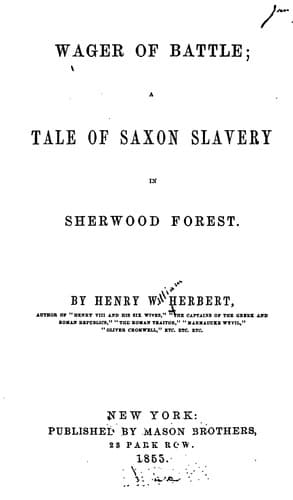
Wager of Battle: A Tale of Saxon Slavery in Sherwood ForestHerbert, Henry William
History
Wager of Battle: A Tale of Saxon Slavery in Sherwood Forest
Herbert, Henry William
Anglo-Saxons -- Fiction; Great Britain -- History -- Norman period, 1066-1154 -- Fiction; Sherwood Forest (England) -- Fiction
It was a strange and moving scene on which they looked. The room,
which was the ordinary dwelling-place of the family, was rather a
large, dark parallelogram, lighted only through the door and a couple
of narrow latticed windows, which, if closed, would have admitted few
half-intercepted rays, but which now stood wide open, to admit the
fresh and balmy air, so that from one, at the western end of the
cottage, a clear ruddy beam of the declining sun shot in a long pencil
of light, bringing out certain objects in strong relief against the
surrounding gloom.
The door, at which the two knights stood, chanced to be so placed
under the shadow of one of the great trees which overhung the house,
that there was little light for them to intercept. Hence, those who
were within, occupied by their own sad and bitter thoughts, did not at
first so much as observe their presence. Facing the entrance, a large
fire-place, with great projecting jambs, inclosing on each side a long
oaken settle, occupied one half the length of the room; and on one of
these, propped up with some spare bedding and clothing, lay the
wounded man, Kenric, to whom the Baron de Taillebois owed his beloved
child's life, half recumbent, pale from the loss of blood, yet chafing
with annoyance, that he should be thus bedridden, when his strength
might have been of avail to others, feebler and less able to exert
themselves almost than he, bruised though he was, and gored from the
rude encounter.
A little fire was burning low on the hearth, with a pot simmering over
it--for, in their bitterest times of anguish and desolation, the very
poor must bestir themselves, at least, to house service--and from the
logs, which had fallen forward on the hearth, volumes of smoke were
rolling up and hanging thick about the dingy rafters, and the few hams
and flitches which, with strings of oat-cakes garnished the roof, its
only ornament.
But, wholly unconscious of the ill-odored reek, though it streamed up
close under his very eyes, and seeing nothing of the chevaliers, who
were watching not six paces from him, Kenric lay helpless, straining
his nerveless eyes toward the spot where the ruddy western sunlight
fell, like a glory, on the pale, quiet features of the dead child, and
on the cold, gray, impassive head of the aged mourner, aged far beyond
the ordinary course of mortal life, who bent over the rude bier; and,
strange contrast, on the sunny flaxen curls, and embrowned ruddy
features of two or three younger children, clustered around the
grandam's knee, silent through awe rather than sorrow, for they were
too young as yet to know what death meant, or to comprehend what was
that awful gloom which had fallen upon hearth and home.
Public-domain text, read in full here on John Shaqi.
Reviews
Reviews
No reviews yet
Be the first to share your thoughts on this work.
Join the Discussion
Join the discussion
Sign in to leave a comment or review.
Sign InorCreate an account