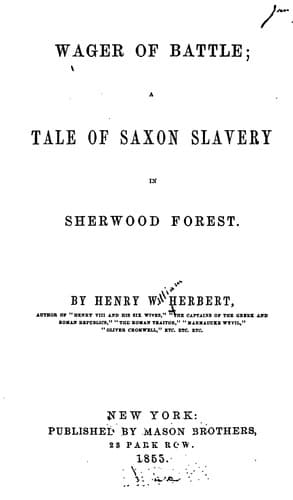
Wager of Battle: A Tale of Saxon Slavery in Sherwood ForestHerbert, Henry William
History
Wager of Battle: A Tale of Saxon Slavery in Sherwood Forest
Herbert, Henry William
Anglo-Saxons -- Fiction; Great Britain -- History -- Norman period, 1066-1154 -- Fiction; Sherwood Forest (England) -- Fiction
It is, however, I fear, but too much the case even with the more
refined and better nurtured classes of the present century, while they
are compassionating the sorrows and even endeavoring to alleviate the
miseries of their poorer and less-cultivated brethren, to undervalue
the depth of their sensations, to fancy that the same events harrow
not up their less vivid sensibilities, and inflict not on their
coarser and less intellectual natures the same agonies, which they
effect upon their own. But, although it may be true that, in the very
poor, the necessity of immediate labor, of all-engrossing occupation,
rendering thought and reflection on the past impossible, sooner
removes from them the pressure of past grief, than from those who can
afford to brood over it in indolent despair, and indulge in morbid and
selfish woe, there can be no doubt that, in the early moments of a new
bereavement, the agony is as acute to the dullest and heaviest as to
the loftiest and most imaginative intellect. Since it is the heart
itself, that is touched in the first instance; and, though in after
hours imagination may assume its share, so that the most imaginative
minds dwell longest on the bygone suffering, the heart is the same in
the peasant as in the peer, and that of the wisest of the sons of men
bleeds neither more nor less profusely than that of the rudest clown.
And so, perchance, in some sort it was now. For, after pausing and
looking reverently on the sad picture, until it was evident that they
were entirely overlooked, if not unseen, Sir Philip de Morville took a
step or two forward into the cottage, his sounding tread at once
calling all eyes toward his person, in a sort of half-stupid mixture
of alarm and astonishment.
For in those days, the steps of a Norman baron rarely descended to the
serf's quarters, unless they were echoed by the clanking strides of
armed subordinates, and too often followed by the clash of shackles or
the sound of the hated scourge. Sir Philip was indeed, as it has been
observed, an even-tempered and just master, as things went in those
times; that is to say, he was neither personally cruel nor exacting of
labor; nor was he niggardly in providing for his people; nor did he,
when it came before his eyes, tolerate oppression, or permit useless
severity on the part of subordinates, who were often worse tyrants and
tormentors than the lords. Still, his kindliest mood amounted to
little more than bare indifference; and he certainly knew and studied
less concerning any thing beyond the mere physical wants and condition
of his thralls and bondsmen, than he did of the nurture of his hawks
or hounds.
All the inmates, therefore, looked up in wonder, not altogether
unmixed with fear, as, certainly for the first time in his life, the
castellan entered the humble tenement of the serf of the soil.
Public-domain text, read in full here on John Shaqi.
Reviews
Reviews
No reviews yet
Be the first to share your thoughts on this work.
Join the Discussion
Join the discussion
Sign in to leave a comment or review.
Sign InorCreate an account