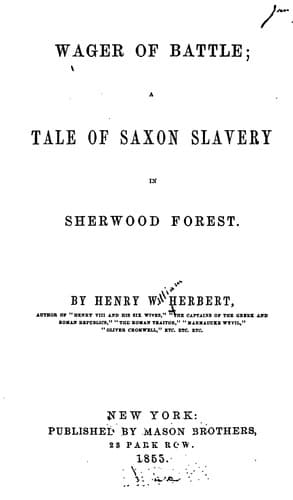
Wager of Battle: A Tale of Saxon Slavery in Sherwood ForestHerbert, Henry William
History
Wager of Battle: A Tale of Saxon Slavery in Sherwood Forest
Herbert, Henry William
Anglo-Saxons -- Fiction; Great Britain -- History -- Norman period, 1066-1154 -- Fiction; Sherwood Forest (England) -- Fiction
But all idea of fear passed away on the instant; for the knight's face
was open and calm, though grave, and his voice was gentle, and even
subdued, as he spoke.
"Soh!" he said, "what is this, Kenric, which causes us, in coming down
to see if we might not heal up thy heart and cheer thy spirits by good
tidings, to find worse sorrow, for which we looked not, nor can
reverse it by any mortal doing. Who is the boy?"
"Pardon that I rise not, beausire, to reply to you," answered the
serf, "but this right leg of mine will not bear me; and when the hand
of sickness hold us down, good will must make shift in lieu of good
service. It is my nephew Adhemar, Sir Philip, the only son of my
youngest brother Edgar, who was drowned a year since in the great
flood of the Idle."
"In striving to rescue my old blind destrier Sir Roland, ah! I
remember him; a stout and willing lad! But I knew not, or forgot, that
he was thy brother. And so this is his son," he added, striding up to
the side of the rude bier, and laying his broad hand upon his brow.
"He is young," he said, musingly, "very young to die. But we must all
die one day, Kenric; and who knows but it is best to die young?"
"At least, the ancient Greeks and Romans said so," interposed Yvo de
Taillebois, speaking for the first time. "They have a proverb, that,
whomsoever the gods love, dies young."
"I think it _is_ best, beausire," answered the serf; "it is never
cold in the grave, in the dreariest storms; nor sultry in the
scorching August. And they are never hungry there, nor sorefooted, nor
weary unto death. I think it is best to die young, before one has
tasted overmuch sorrow here on earth to burden his heart and make him
stubborn and malicious. It was this I was saying to old Bertha, as
your noblenesses entered; but she has never held her head up since my
brother, Edgar, died; he was her favorite, since she always held that
he had most favor of our grandfather."
"She is very old?" said Sir Philip, half questioning, half musing.
"She is very old?"
"Above ninety years, Sir Philip, I have heard Father Eadbald say, who
died twenty years since, at the abbey, come next Michaelmas. It should
have been he who married her. Her mother was the last free woman of
our race. We had three hydes of land, I've heard her tell, in those
days, down by the banks of Idle, held of old Waltheof, who gave his
name to this your noble castle. But they are all gone before us, and
we must follow them when our day comes. And then, as I tell Bertha, we
shall be free, all, if not equal; for the most virtuous must be
_first_ there, as Father Engelram tells us. May Mary and the saints
be about us!"
Public-domain text, read in full here on John Shaqi.
Reviews
Reviews
No reviews yet
Be the first to share your thoughts on this work.
Join the Discussion
Join the discussion
Sign in to leave a comment or review.
Sign InorCreate an account