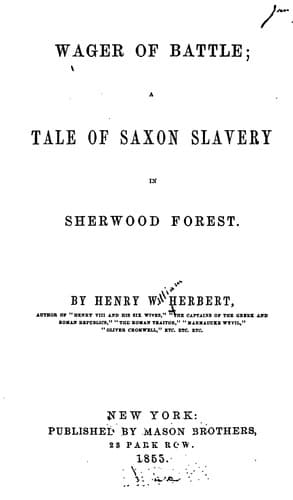
Wager of Battle: A Tale of Saxon Slavery in Sherwood ForestHerbert, Henry William
History
Wager of Battle: A Tale of Saxon Slavery in Sherwood Forest
Herbert, Henry William
Anglo-Saxons -- Fiction; Great Britain -- History -- Norman period, 1066-1154 -- Fiction; Sherwood Forest (England) -- Fiction
"Come, Kenric," said De Morville, cheeringly, "thou talkest now more
like to a gray brother, than to the stout woodman who struckest yon
brave blow but a while since, and saved Sir Yvo's fair lady,
Guendolen. Faith! it was bravely done, and well; and well shall come
of it to you, believe me. It is to speak of that to thee that we came
hither, but this boy's death hath put it from our minds. But, hark ye,
boy! I will send down some wenches hither from the castle, with ale
and mead for his lykewake, and linen for a shroud; and Father Engelram
shall see to the church-service; and there shall be a double dole to
the poor at the abbey; and I myself will pay ten marks, in masses for
his soul. If he died a serf, he shall be buried as though he were a
freeman, and a franklin's son; and all for thy sake, and for the good
blow thou struckest but three hours agone."
Kenric's brow flushed high, whether it was with gratification, or
gratitude, or from wounded pride; but he stuttered confusedly, as he
attempted to thank his lord, and only found his tongue as he related
to his grandmother, in his native language, the promises and goodly
proffers of the castellan; and she, for a moment, spoke eagerly in
reply, but then seemed to forget, and was silent. A word or two passed
in French between the nobles, Yvo de Taillebois urging that the time
was inopportune for speaking of the matter on which they had come
down; for that it was not well to mingle great joys with great
sorrows; but Sir Philip insisted, declaring that there was no so good
way to cure a past grief as by the news of a coming joy.
"So, hark you, Kenric," he said; "the cure we came to bring you for
your bruised bones, and the guerdon for your gallant deed, in two
words, is this--I may not, as you may have heard tell, liberate my
serfs, under condition, but I may _sell_; and I have sold thee to
mine ancient friend and brother in arms, Yvo de Taillebois."
"Not to hold in thrall," exclaimed Yvo de Taillebois, eagerly, as he
saw the face of the wounded man flush fiery red, and then grow pale as
ashes. "Not to hold in thrall, but to liberate; but to make thee as
free as the birds of the wildest wing--a freeman; and, if thou wilt
follow me, a freeholder on my lands beyond the lakes, in the fair
shire of Westmoreland."
"I am a serf of the soil, Beausire de Morville, and I may not be sold
from the soil, unless legally convicted of felony. I know no felony
that I have done, Sir Philip."
"Felony, man!" exclaimed Sir Philip; "art thou mad? We would reward
thee for thy good faith and valor. We would set thee free. Of course,
thou canst not be sold, but with thine own consent. But thou hast only
to consent, and be free as thy master."
"Sir Philip," replied the man, turning even paler than before, and
trembling, as if he had a fit of palsy, "would I could rise to bless
you, on my bended knee! May the great God of all things bless you! but
I can not consent--think me not ungrateful--but I can not be free!"
Public-domain text, read in full here on John Shaqi.
Reviews
Reviews
No reviews yet
Be the first to share your thoughts on this work.
Join the Discussion
Join the discussion
Sign in to leave a comment or review.
Sign InorCreate an account