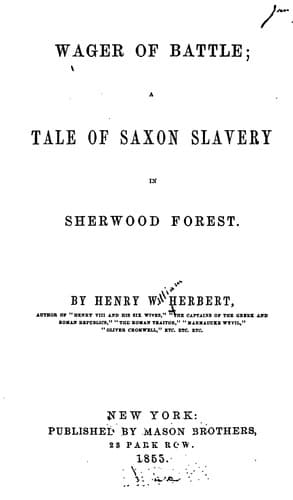
Wager of Battle: A Tale of Saxon Slavery in Sherwood ForestHerbert, Henry William
History
Wager of Battle: A Tale of Saxon Slavery in Sherwood Forest
Herbert, Henry William
Anglo-Saxons -- Fiction; Great Britain -- History -- Norman period, 1066-1154 -- Fiction; Sherwood Forest (England) -- Fiction
"But I have!" answered Kenric; "when the beast's brood were within,
and might not follow him. But I am _not_ a beast, Sir Knight; but
though a serf, a man--a Saxon, not a Norman, it is true; but a man,
yet, _a man_! There may be collar on my neck, and gyves on wrist
and ankle, but my soul wears no shackles. It is as free as thine, and
shall stand face to face with thine, one day, before the judgment
seat. I am a man, I say, Sir Yvo de Taillebois; there sits old Bertha,
surnamed the Good, a serf herself, mother of serfs, and grandmother;
there lies my serf-brother's boy, himself a serf no longer; there
sprawl unconscious on the hearth his baby brethren, serfs from the
cradle to the grave; and here comes," he added, in a deeper, sterner,
lower tone, as the beautiful Saxon slave-girl entered, whom they had
seen near the drawbridge, washing in the stream--"here comes--look
upon her, noble knight and Norman!--here comes my plighted bride, my
Edith the fair-haired! I am a man, Norman! Should I be man, or beast,
if, leaving these in bondage, I were to fare forth hence, alone, into
dishonored freedom?"
CHAPTER VII.
THE SLAVE GIRL'S SELF-DEVOTION.
"I say not nay, but that all day,
It is both writ and said,
That woman's faith is, as who sayeth,
All utterly decayed;
But neverthelesse, right good witnesse
In this case might be laid,
That they love true and continue--
Recorde the Not-browne mayde;
Which, when her love came her to prove,
To her to make his mone,
Wolde have him part--for in her hart
She loved him but alone."
THE NOT-BROWNE MAYDE.
How true a thing is it of the human heart, and alas! how pitiful a
thing, that use has such wondrous power over it, whether for good or
for evil; but mostly--perhaps because such is its original
nature--unto evil. Custom will harden the softest spirit to the
ice-brook's temper, and blind the clearest philosophic eye to all
discrimination, that things the most horrible to behold shall be
beheld with pleasure, and things the most unjust regarded as simple
justice, or, at least, as the inevitable course and pervading law of
nature. True as this is, in all respects, in none is it more clearly
or fatally discoverable than in every thing connected with what may be
called slavery, in the largest sense--including the subjugation, by
whatever means, not only of man to man, but even of animals to the
human race. In all such cases, it would appear that the hardening and
deteriorating influence of habit, and perhaps the unavoidable tendency
to believe every thing subordinate as in itself inferior, soon brings
the mind to regard the power to enforce and the capacity to perform,
as the rule of justice between the worker and the master.
Public-domain text, read in full here on John Shaqi.
Reviews
Reviews
No reviews yet
Be the first to share your thoughts on this work.
Join the Discussion
Join the discussion
Sign in to leave a comment or review.
Sign InorCreate an account