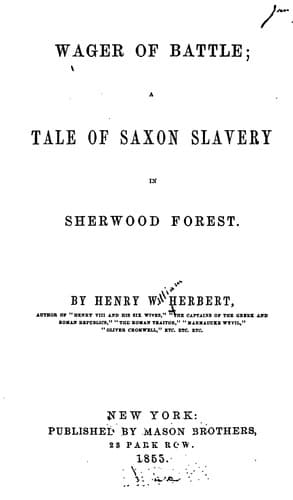
Wager of Battle: A Tale of Saxon Slavery in Sherwood ForestHerbert, Henry William
History
Wager of Battle: A Tale of Saxon Slavery in Sherwood Forest
Herbert, Henry William
Anglo-Saxons -- Fiction; Great Britain -- History -- Norman period, 1066-1154 -- Fiction; Sherwood Forest (England) -- Fiction
She had seen these serfs, rudely attired indeed, and employed in
rugged, laborious, and menial occupations; but, then, it was clear
that their boorish demeanor, stolid expression, and apparent lack of
capacity or intelligence for any superior employment, seemed to
indicate them as persons filling the station in society for which
nature had adapted them. Well-clad, sufficiently clothed, warmly
lodged--in all outward things perhaps equal, if not superior, to the
peasantry of most European countries in the present day--never, except
in extreme and exceptional cases, cruelly or severely treated, since
it was ever the owner's interest to regard the well-doing of his
serfs, it had never occurred to her that the whole race was in itself,
from innate circumstances, and apart from extraordinary sorrows or
sufferings, hopeless, miserable, and conscious of unmerited but
irretrievable degradation.
Had she considered the subject, she would of course have perceived and
admitted that sick or in health, sorrowful or at ease, to be compelled
to toil on, toil on, day after day, wearily, at the bidding and for
the benefit of another, deriving no benefit from that toil beyond a
mere subsistence, was an unhappy and forlorn condition. Yet, how many
did she not see of her own conquering countrymen of the lower orders,
small landholders in the country, small artisans and mechanics in the
boroughs, reduced to the same labors, and nearly to the same
necessity.
With the personal condition or habits of the serfs, the ladies and
even the lords of the great Norman families had little acquaintance,
little means even of becoming acquainted. The services of their
fortalices, all but those menial and sordid offices of which those
exalted persons had no cognizance, were discharged by domestics,
higher or lower in grade, the highest being of gentle blood, and, in
very noble houses, even of noble blood, of their own proud race; and
the Saxons, whether bond-servants of the soil, or, what was of rare
occurrence at that time, free tenants on man service, were employed in
the fields or in the forest, under the bailiff or overseer, who ruled
them at his own discretion, and punished them, if punishment were
needed, with the stocks, the gyves, or the scourge, without consulting
the lord, and of course without so much as the knowledge of the lady.
Even if, by hazard, it did reach the dainty ears of some fair
chatelaine, that Osrick or Edmund had undergone the lash for some
misdoing or short-coming, she heard of it much as a modern lady would
read of the committal of a pickpocket or drunkard to the treadmill, or
of a vagrant hussy to pick hemp; wondering why those low creatures
would do such wicked things, and sorrowfully musing why such
punishments should be necessary--never suspecting the injustice of the
law, or doubting the necessity of the punishment.
Public-domain text, read in full here on John Shaqi.
Reviews
Reviews
No reviews yet
Be the first to share your thoughts on this work.
Elsewhere in the archive
Join the Discussion
Join the discussion
Sign in to leave a comment or review.
Sign InorCreate an account