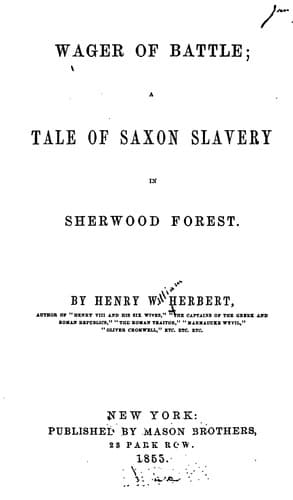
Wager of Battle: A Tale of Saxon Slavery in Sherwood ForestHerbert, Henry William
History
Wager of Battle: A Tale of Saxon Slavery in Sherwood Forest
Herbert, Henry William
Anglo-Saxons -- Fiction; Great Britain -- History -- Norman period, 1066-1154 -- Fiction; Sherwood Forest (England) -- Fiction
And eminently thus it was with Guendolen. While in her good aunt's
priory, she had ever seen the serfs of the church well looked after,
well doing, not overworked, not oppressed, cared for if sick,
comforted if sorrowing, well tended in age, a contented if not a happy
race, so far as externals only were regarded, and nothing hitherto had
led her to look farther than to externals. On her father's princely
barony she saw even less of them than she had been accustomed to do at
the priory, passing them casually only when in the fields at
hay-making or harvest work, or pausing perhaps to observe a
rosy-cheeked child in the Saxon quarter, or to notice a cherry-lipped
maiden by the village well. But here, too, so far as she did see, she
saw them neither squalid nor starved, neither miserable nor
maltreated. No acts of tyranny or cruelty reached her ears, perhaps
none happened which should reach them; and of the rigorous,
oppressive, insolent, and cruel laws which regulated their condition,
controlled their progress, prevented their rise in the social scale,
fettered and cramped their domestic relations, she knew nothing.
Since her sojourn at Waltheofstow, she had gained more personal
acquaintance with her down-trodden Saxon countrymen and countrywomen,
and more especially since her accident in the forest, than in all her
previous life.
For, in the first place, Sir Philip de Morville, being unmarried and
without female relations in his family, had no women of Norman blood
employed as attendants or domestics in the castle, the whole work of
which was performed by serf girls of various degrees, under the
superintendence of an emancipated Saxon dame, who presided over what
we should now call the housekeeper's department. Of these girls,
Edith, and one or two others, Elgythas, Berthas, and the like,
ministered to the Lady's Bower, and having perhaps contracted
something of unusual refinement and expression from a nearer
attendance on the more courtly race, and especially on the Norman
ladies who at times visited the castle, presented, it is certain,
unusually favorable specimens of the Saxon peasantry, and had
attracted the attention of Guendolen in a greater degree than any
Saxons she had previously encountered.
Public-domain text, read in full here on John Shaqi.
Reviews
Reviews
No reviews yet
Be the first to share your thoughts on this work.
Elsewhere in the archive
Join the Discussion
Join the discussion
Sign in to leave a comment or review.
Sign InorCreate an account