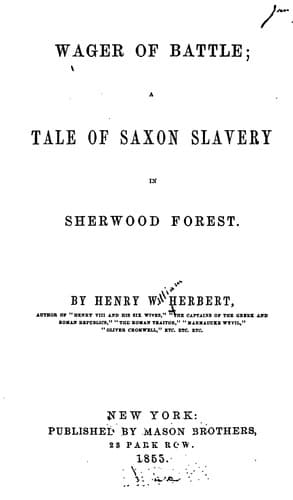
Wager of Battle: A Tale of Saxon Slavery in Sherwood ForestHerbert, Henry William
History
Wager of Battle: A Tale of Saxon Slavery in Sherwood Forest
Herbert, Henry William
Anglo-Saxons -- Fiction; Great Britain -- History -- Norman period, 1066-1154 -- Fiction; Sherwood Forest (England) -- Fiction
Not now, as then, embracing in its green bosom sparse tracts of
cultivated lands, with a few borough-towns, and a few feudal keeps, or
hierarchal abbayes, but itself severed into divers and far-distant
parcels, embosomed in broad stretches of the deepest meadows, the most
teeming pastures, or girded on its swelling, insulated knolls by the
most fertile corn-lands, survives the ancient Sherwood.
Watered by the noblest and most beautiful of northern rivers, the calm
and meadowy Trent, the sweet sylvan Idle, the angler's favorite,
fairy-haunted Dee, the silver Eyre, mountainous Wharfe, and pastoral
Ure and Swale; if I were called upon to name the very garden-gem of
England, I know none that compares with this seat of the old-time
Saxon forest.
You can not now travel a mile through that midland region of plenty
and prosperity without hearing the merry chime of village bells from
many a country spire, without passing the happy doors of hundreds of
low cottage homes, hundreds of pleasant hamlets courting the mellow
sunshine from some laughing knoll, or nestling in the shrubberies of
some orchard-mantled hollow.
Nor are large, prosperous, and thriving towns, rich marts of
agricultural produce, or manufactures of wealth richer than gold of El
Dorado, so far apart but that a good pedestrian may travel through the
streets of a half a dozen in a day's journey, and yet stand twenty
times agaze between their busy precincts in admiration--to borrow the
words of the great northern Romancer, with the scene and period of
whose most splendid effort my humble tale unfortunately coincides--in
admiration of the "hundreds of broad-headed, short-stemmed,
wide-branched oaks, which had witnessed, perhaps, the stately march of
the Roman soldiers."
And here, let none imagine these to be mere exaggerations, sprung from
the overflowing brain of the Romancer, for, not fifty miles distant
from the scene described above, there is yet to be seen a venerable
patriarch of Sherwood, which boasted still, within a few short years,
some garlands of surviving green--the oak of Cowthorpe--probably the
largest in the island; which is to this day the boundary corner of
two marching properties, and has been such since it was constituted
so in Doomsday Book, wherein it was styled _quercum ingentem_, the
gigantic oak.
Since the writing of those words eight centuries have passed, and
there are many reasons for believing that those centuries have added
not an inch to its circumference, but rather detracted from its vigor
and its growth; and, to me, it seems far more probable that it was a
full-grown tree, with all its leafy honors rife upon it, when the
first Cæsar plunged, waist-deep, into the surges of the British
Channel from the first Roman prow, than that it should have sprung up,
like the gourd of a Jonah, in a single night, to endure a thousand
years' decay without entirely perishing.
Public-domain text, read in full here on John Shaqi.
Reviews
Reviews
No reviews yet
Be the first to share your thoughts on this work.
Join the Discussion
Join the discussion
Sign in to leave a comment or review.
Sign InorCreate an account