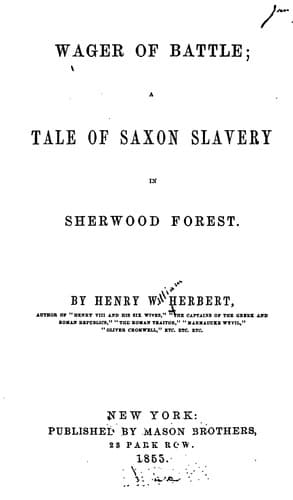
Wager of Battle: A Tale of Saxon Slavery in Sherwood ForestHerbert, Henry William
History
Wager of Battle: A Tale of Saxon Slavery in Sherwood Forest
Herbert, Henry William
Anglo-Saxons -- Fiction; Great Britain -- History -- Norman period, 1066-1154 -- Fiction; Sherwood Forest (England) -- Fiction
Only in the south-western corner of Westmoreland, the lovely land of
lakes and mountains and green pastoral glens, beyond Morecambe Bay and
the treacherous sands of Lancaster, had the Norman nobles, as the
entering tide swept upward through the romantic glens and ghylls of
Netherdale and Wharfedale, past the dim peaks of Pennigant and
Ingleborough, established their lines in those pleasant places, and
reared their castellated towers, and laid out their noble chases,
where they had little interruption to apprehend from the tyrannic
forest laws of the Norman kings, which, wherever their authority
extended, bore not more harshly on the Saxon serf than on the Norman
noble.
To return, however, toward the midland counties, and the rich regions
with which this brief survey of Northern England in the early years of
the twelfth century commenced--a vast tract of country, including much
of the northern portions of Nottingham and Derbyshire, and all the
south of the West Riding of York, between the rivers Trent and Eyre,
was occupied almost exclusively by that most beautiful and famous of
all British forests, the immemorial and time-honored Sherwood--theme
of the oldest and most popular of English ballads--scene of the most
stirring of the old Romaunts--scene of the most magnificent of modern
novels, incomparable Ivanhoe--home of that half historic personage,
King of the Saxon greenwoods, Robin Hood, with all his northern
merry-men, Scathelock, and Friar Tuck, and Little John, Allen-a-Dale,
wild forest minstrel, and the blythe woodland queen, Maid Marion--last
leafy fortalice, wherein, throughout all England proper, lingered the
sole remains of Saxon hardihood and independence--red battle-field of
the unsparing conflicts of the rival Roses.
There stand they still, those proud, majestic kings of bygone ages;
there stand they still, the
"Hallowed oaks,
Who, British-born, the last of British race,
Hold their primeval rights by nature's charter,
Not at the nod of Cæsar;"
there stand they still, erect, earth-fast, and massive, grasping the
green-sward with their gnarled and knotty roots, waving "their free
heads in the liberal air," full of dark, leafy umbrage clothing their
lower limbs; but far aloft, towering with bare, stag-horned, and
splintered branches toward the unchanged sky from which so many
centuries of sunshine have smiled down, of tempest frowned upon their
"secular life of ages."
There stand they, still, I say; alone, or scattered here and there, or
in dark, stately groups, adorning many a noble park of modern days, or
looming up in solemn melancholy upon some "one-tree hill," throughout
the fertile region which lies along the line of that great ancient
road, known in the Saxon days as Ermine-street, but now, in common
parlance, called "the Dukeries," from seven contiguous domains,
through which it sweeps, of England's long-lined nobles.
Public-domain text, read in full here on John Shaqi.
Reviews
Reviews
No reviews yet
Be the first to share your thoughts on this work.
Join the Discussion
Join the discussion
Sign in to leave a comment or review.
Sign InorCreate an account