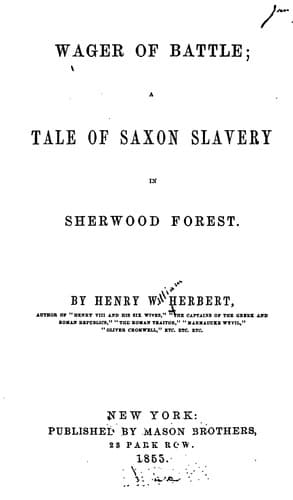
Wager of Battle: A Tale of Saxon Slavery in Sherwood ForestHerbert, Henry William
History
Wager of Battle: A Tale of Saxon Slavery in Sherwood Forest
Herbert, Henry William
Anglo-Saxons -- Fiction; Great Britain -- History -- Norman period, 1066-1154 -- Fiction; Sherwood Forest (England) -- Fiction
Hence a division, which never can be reconciled. Both classes have
receded from the true nature of humanity, in the two opposite
directions, that they no longer even comprehend the one the tastes of
the other, and scarce have a desire or a hope in common; for what the
poor man most desires, a sufficiency for his mere wants, physical and
moral, the rich man can not comprehend, never having known to be
without it; while the artificial nothings, for which the capitalist
strives and wrestles to the last, would be to his workman mere
syllabub and flummery to the tired and hungry hunter.
In those days the enjoyments, and, in a great measure, the tastes, of
all men were alike, from the highest to the lowest--the same sports
pleased them, the same viands, for the most part, nourished, the same
liquors enlivened them. Fresh meat was an unusual luxury to the noble,
yet not an impossible indulgence to the lowest vassal; wine and beer
were the daily, the sole, beverages of all, differing only, and that
not very widely, in degree. The same love of flowers, processions,
out-of-door amusements, dances on the greensward, suppers in the
shade, were common to all, constantly enjoyed by all.
Now, it is certain, the enjoyments, the luxuries of the one class--nay,
the very delicacy of their tables, if attainable, would be utterly
distasteful to the other; and the rich soups, the delicate-made
dishes, the savor of the game, and the purity of the light French and
Rhenish wines, which are the _ne plus ultra_ of the rich man's
splendid board, would be even more distasteful to the man of the
million, than would be his beans and bacon and fire-fraught whisky to
the palate of the gaudy millionaire.
Throughout their progress, therefore, a thousand picturesque
adventures befell our party, a thousand romantic scenes were presented
by their halts for the noon-day repose, the coming meal, or the
nightly hour of rest, which never could now occur, unless to some
pleasure-party, purposely masquerading, and aping the romance of other
days.
Sometimes, when no convent, castle, hostelry, or hermitage, lay on the
day's route, the harbingers would select some picturesque glen and
sparkling fountain; and, when the party halted at the spot, an
extempore pavilion would be found pitched, of flags and pennoncelles,
outspread on a lattice-work of lances, with war-cloaks spread for
cushions, and flasks and _bottiaus_ cooling in the spring, and
pasties and boar's meat, venison and game, plates of silver and
goblets of gold, spread on the grass, amid pewter-platters and
drinking-cups of horn, a common feast for man and master, partaken
with the same appetite, hallowed by the same grace, enlivened by
the same minstrelsy and music, and enjoyed no less by the
late-enfranchised serfs, than by the high-born nobles to whom they
owed their freedom.
Public-domain text, read in full here on John Shaqi.
Reviews
Reviews
No reviews yet
Be the first to share your thoughts on this work.
Elsewhere in the archive
Join the Discussion
Join the discussion
Sign in to leave a comment or review.
Sign InorCreate an account