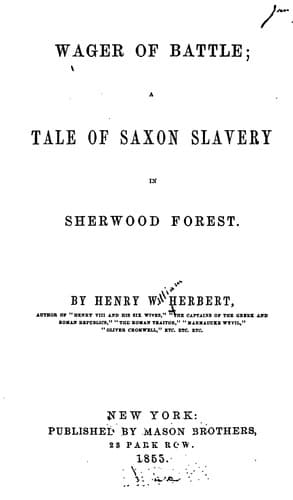
Wager of Battle: A Tale of Saxon Slavery in Sherwood ForestHerbert, Henry William
History
Wager of Battle: A Tale of Saxon Slavery in Sherwood Forest
Herbert, Henry William
Anglo-Saxons -- Fiction; Great Britain -- History -- Norman period, 1066-1154 -- Fiction; Sherwood Forest (England) -- Fiction
Sometimes, when it was known beforehand that they must encamp for
the night in the greenwood, the pages and waiting-women would ride
forward, in advance of the rest, with the foragers, the baggage, and a
portion of the light-armed archery; and, when the shades of evening
were falling, the welcome watch-setting of the mellow-winded bugles
would bid the voyagers hail; and, as they opened some moon-lit grassy
glade, they would behold green bowers of leafy branches, garlanded
with wild roses and eglantine, and strewn with dry, soft moss, and
fires sparkling bright amid the shadows, and spits turning before the
blaze, and pots seething over it, suspended from the immemorial gipsy
tripods. And then the horses would be unbridled, unladen, groomed, and
picketed, to feed on the rich forest herbage; and the evening meal
would be spread, and the enlivening wine-cup would go round, and the
forest chorus would be trolled, rendered doubly sweet by the soft
notes of the girls, until the bugles breathed a soft good-night, and,
the females of the party withdrawing to their bowers of verdure, meet
tiring rooms for Oberon and his wild Titania, the men, from the
haughty baron to the humblest groom, would fold them in their cloaks,
and sleep, with their feet to the watch-fires, and their untented
brows toward heaven, until the woodlark, and the merle and mavis,
earlier even than the village chanticleer, sounded their forest
reveillé.
CHAPTER XIII.
THE PROGRESS.
"Great mountains on his right hand,
Both does and roes, dun and red,
And harts aye casting up the head.
Bucks that brays and harts that hailes,
And hindes running into the fields,
And he saw neither rich nor poor,
But moss and ling and bare wild moor."
SIR EGER, SIR GREYSTED, AND SIR GRYME.
In this life there was much of that peculiar charm which seems to
pervade all mankind, of whatever class or country, and in whatever
hemisphere; which irresistibly impels him to return to his, perhaps,
original and primitive state, as a nomadic being, a rover of the
forest and the plain; which, while it often seduces the refined and
civilized man of cities to reject all the conveniences and luxuries of
polite life, for the excitement and freshness, the inartificial
liberty and self-confiding independence of semi-barbarism, has never
been known to allow the native savage to renounce his freeborn
instincts, or to abandon his natural and truant disposition, for all
the advantage, all the powers, conferred by civilization.
Public-domain text, read in full here on John Shaqi.
Reviews
Reviews
No reviews yet
Be the first to share your thoughts on this work.
Elsewhere in the archive
Join the Discussion
Join the discussion
Sign in to leave a comment or review.
Sign InorCreate an account