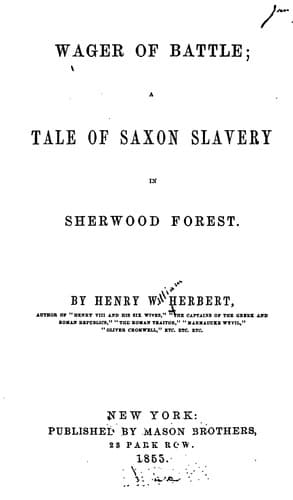
Wager of Battle: A Tale of Saxon Slavery in Sherwood ForestHerbert, Henry William
History
Wager of Battle: A Tale of Saxon Slavery in Sherwood Forest
Herbert, Henry William
Anglo-Saxons -- Fiction; Great Britain -- History -- Norman period, 1066-1154 -- Fiction; Sherwood Forest (England) -- Fiction
And if, even to the freeborn and lofty-minded noble, the careless,
unconventional, equalizing life of the forest was felt as giving a
stronger pulsation to the free heart, a wider expansion to the lungs,
a deeper sense of freedom and power, how must not the same influences
have been enjoyed by those, who now, for the first time since they
were born, tasted that mysterious thing, liberty--of which they had so
often dreamed, for which they had longed so wistfully, and of which
they had formed, indeed, so indefinite an idea--for it is one of the
particulars in the very essence of liberty, as it is, perhaps, of that
kindred gift of God, health, that although all men talk of it as a
thing well understood and perfectly appreciated, not one man in ten
understands or appreciates it in the least, unless he has once enjoyed
it, and then been deprived of its possession.
It is true that, personally, neither Kenric nor Edith had ever known
what it is to be free; but they came of a free, nay! even of an
educated stock, and, being children of that Northern blood, which
never has long brooked even the suspicion of slavery, and, in some
sort, of the same race with their conquerors and masters, they had
never ceased to feel the consciousness of inalienable rights; the
galling sense of injustice done them, of humiliating degradation
inflicted on them, by their unnatural position among, but not of,
their fellows; had never ceased to hope, to pray, and to labor for a
restitution to those self-existing and immutable rights--the rights, I
mean, of living for himself, laboring for himself, acquiring for
himself, holding for himself, thinking, judging, acting for himself,
pleasing and governing himself, so long as he trench not on the
self-same right of others--to which the meanest man that is born of a
woman is entitled, from the instant when he is born into the world, as
the heir of God and nature.
The Saxon serf was, it is true, a being fallen, debased, partially
brutalized, deprived of half the natural qualities of manhood, by the
state of slavery, ignorance, and imbecility, into which he had been
deforced, and in which he was willfully detained by his masters; but
he had not yet become so utterly degraded, so far depressed below the
lowest attributes of humanity, as to acquiesce in his own debasement,
much less to rejoice in his bondage for the sake of the flesh-pots of
Egypt, or to glory in his chains, and honor the name of master.
Public-domain text, read in full here on John Shaqi.
Reviews
Reviews
No reviews yet
Be the first to share your thoughts on this work.
Elsewhere in the archive
Join the Discussion
Join the discussion
Sign in to leave a comment or review.
Sign InorCreate an account