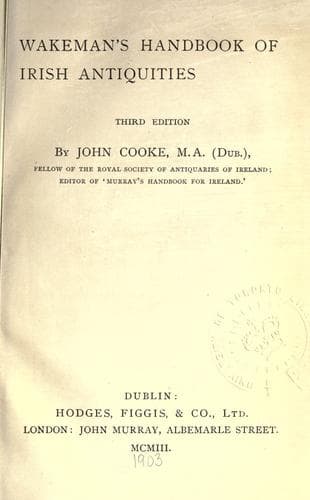
Wakeman's handbook of Irish antiquitiesWakeman, W. F. (William Frederick)
History
Wakeman's handbook of Irish antiquities
Wakeman, W. F. (William Frederick)
Ireland -- Antiquities
Irish Antiquarian remains may be generally classified under three
heads:--I. Prehistoric, embracing those which are considered to have
existed previous to, or within a limited period after, the introduction
of Christianity in the fifth century; II. The Early Christian; and III.
The Anglo-Irish.
The Prehistoric remains consist of cromlechs, pillar-stones, cairns,
stone circles, tumuli, raths, stone forts, beehive huts, rock-markings,
weapons, &c. They are found in considerable numbers particularly in
the more remote parts of the island, where they have been suffered to
remain, many more or less unmolested, save by the hand of time.
Early Christian remains are very numerous, and consist of oratories,
churches, round towers, Ogam stones, and crosses. Of the early churches
of Ireland--structures of a period when the ‘Scotish (Irish) monkes in
Ireland and Britaine highly excelled in their holinesse and learning,
_yea, sent forth whole flockes of most devout men into all parts of
Europe_’[1]--there are examples in a sufficient state of preservation
to give a good idea of architecture, in what may be considered its
second stage in Ireland.
The remains of what may be termed ‘Anglo-Irish’ structures were
erected about the period of the English invasion, and although of
Irish foundation, they appear generally to have been built upon
Anglo-Norman or English models. The great barons who, in the time of
Henry the Second, or of his immediate successors, received grants of
land from the Crown, erected fortresses of considerable strength and
extent, in order to preserve their possessions from the inroads of
the native Irish, with whom they were usually at war. The castles of
Howth, Malahide, Maynooth, Trim, Carlow, and many others, are silent
witnesses to the fact that the early invaders were occasionally obliged
to place some faith in the efficacy of strong walls and towers to
resist the advances of their restless neighbours, who, for several
centuries subsequent to the Invasion, were rather the levellers than
the builders of castles. Of the massive square keep, so common in
every part of the kingdom, but especially within the English Pale,
the Dublin neighbourhood furnishes several examples. As, except in
some minor details, they usually bear a great resemblance to each
other, an inspection of one or two will afford a just idea of all.
They were generally used as the residence of a chieftain, or as an
outpost dependent upon some larger fortress in the neighbourhood. Many
appear to have been erected by English settlers, and they are usually
furnished with a bawn, or enclosure, into which cattle were driven at
night, a precaution very significant of the times.
Public-domain text, read in full here on John Shaqi.
Reviews
Reviews
No reviews yet
Be the first to share your thoughts on this work.
Join the Discussion
Join the discussion
Sign in to leave a comment or review.
Sign InorCreate an account