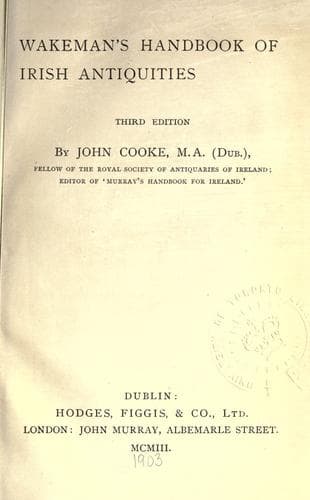
Wakeman's handbook of Irish antiquitiesWakeman, W. F. (William Frederick)
History
Wakeman's handbook of Irish antiquities
Wakeman, W. F. (William Frederick)
Ireland -- Antiquities
The discovery of bronze marked an important epoch in the progress of
human development; and it would be difficult to estimate its full
value as an element in the economic and social conditions of primitive
man and early civilizations. In Ireland as elsewhere, owing to its
advantages, bronze in time came into general use in the manufacture of
weapons, domestic implements, and articles of personal adornment. These
passed through various stages of development; and the use of bronze,
as the general material for all such articles, became in time very
widespread. The percentage of tin in bronze varies, and the proportion
does not appear to be absolutely fixed. About 10 per cent. seems to
have been the average for the best bronze. Some Irish bronze implements
yielded, on analysis, 13·88 per cent.; the Mycenæan bronze which
Schliemann had examined gave 13 per cent. of tin; and some bronze from
Hissarlik gave 4 to 6 per cent. The number of moulds discovered for
various weapons shows that smelting was practised in Ireland; but, like
the mining, it is difficult, if not impossible, to ascertain the exact
method of working, and the extent to which it was carried on.[93]
Archæological opinion is divided as to the origin of bronze. It has
been variously attributed to the high table-land of Central Asia,
to India, to Siberia, and to the original inhabitants of the lower
Euphrates valley, while some writers claim for it an Etruscan origin.
Its antiquity is, however, great; Dr. Flinders Petrie found celts
in the tombs of Medum in Egypt, structures which he considers lead
back to the Third Dynasty; in the Fourth Dynasty, bronze came into
general use.[94] It was characteristic of the whole of the Mycenæan
civilization, and prevailed throughout the Homeric period, though iron
was then known. Bronze spread to Europe from south to north along the
established trade routes; and the theory, once held, that a Bronze Age
developed independently among the rude races of Northern Europe is no
longer accepted. The discovery of well-wrought weapons in early graves
shows that the inhabitants of the British Isles first knew bronze, in
its best form, as a foreign introduction, before they manufactured the
metal for themselves. Bronze was, in time, superseded by iron; but not
until the discovery was made of tempering or hardening it by plunging
the hot metal into cold water. Iron was used by the Egyptians in the
period from 3800 B.C. to 3000 B.C.; in depicting weapons or tools, it
was the custom to paint iron blue or black--the colour by which it was
known--and this is seen in the paintings which have been discovered of
the time. ‘Iron,’ says Dr. Budge, ‘was certainly known to the Egyptians
as early as the Fifth Dynasty; and, from the fact that iron plays a
great part in ancient Egyptian myths, it is probable that it was known
by them at a far earlier period.’[95] Metal tools of the best kind
were known in Egypt at an early date. Dr. Petrie shows that drilling,
Public-domain text, read in full here on John Shaqi.
Reviews
Reviews
No reviews yet
Be the first to share your thoughts on this work.
Elsewhere in the archive
Join the Discussion
Join the discussion
Sign in to leave a comment or review.
Sign InorCreate an account