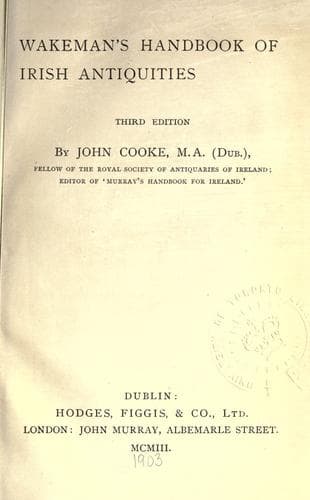
Wakeman's handbook of Irish antiquitiesWakeman, W. F. (William Frederick)
History
Wakeman's handbook of Irish antiquities
Wakeman, W. F. (William Frederick)
Ireland -- Antiquities
_Gold Ornaments._--By far the largest number of important objects for
personal decoration of the Bronze Age found in Ireland are of gold.
The quantity that has been discovered is very large; and Ireland has
perhaps the richest collection in Europe of prehistoric gold ornaments.
There are many references to gold in the Irish ‘Annals’; and, judging
from them, its antiquity in Ireland is great. We are told, under date
3872 A.M.: ‘It was Muineamhon that first caused chains of gold (to be
worn) on the necks of kings and chieftains in Ireland.’ In the _Book
of Rights_, numerous allusions are made to rings, chains, brooches,
and other objects of gold and silver as tribute paid by petty kings and
chiefs to the reigning monarch.
The _Annals of the Four Masters_, at A.M. 3656, state: ‘It was
by Tighearnmas also that gold was first melted in Ireland, in
Foithre-Airthir-Liffe. (It was) Uchadan, an artificer of the
Feara-Cualann, smelted it. It was by him that goblets and brooches
were first covered with gold and silver in Ireland.’ A similar entry
occurs in the _Annals of Clonmacnoise_.[105] The district referred to
includes parts of the counties of Wicklow and Dublin. It is interesting
to note that even to this day gold is found in several of the mountain
streams of Wicklow. In the National Museum may be seen the model of a
Wicklow nugget found in 1796 which weighed 22 ounces; in a few weeks
subsequently, 800 ounces were sold for £3000. One has been found of
nine and another of eight ounces. It has been computed that in the
early part of the last century the jewellers of Dublin paid annually
an average sum of £2000 for nuggets from the Wicklow streams, secretly
sold to them by the finders. Much has been written, and various
theories advanced, to show that the sources from which the ancient
Irish derived gold were foreign, and not native. It has been attributed
to the Levant, Gaul, Spain, and Scandinavia; while one writer labours
to prove that Roman coinage was melted down to supply the material for
the manufacture of ornaments. The instances here given--of Wicklow
furnishing considerable quantities of the precious metal in modern
times--supplies strong presumptive evidence that the main source from
which the ore was derived was Ireland itself.
Public-domain text, read in full here on John Shaqi.
Reviews
Reviews
No reviews yet
Be the first to share your thoughts on this work.
Elsewhere in the archive
Join the Discussion
Join the discussion
Sign in to leave a comment or review.
Sign InorCreate an account