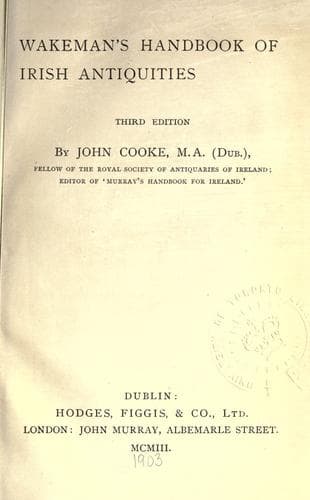
Wakeman's handbook of Irish antiquitiesWakeman, W. F. (William Frederick)
History
Wakeman's handbook of Irish antiquities
Wakeman, W. F. (William Frederick)
Ireland -- Antiquities
Perhaps the most noted example of the pillar-stone, as found in
Ireland, occurs on the celebrated Hill of Tara, Co. Meath. This
interesting monument at present occupies a position in the centre of
the _Forradh_, one of the principal earthworks still remaining on
that memorable site. The stone formerly stood upon, or rather by the
side of, a small mound lying within the enclosure of Rath-na-Riagh,
and called Dumha-na-nGiall, or the ‘Mound of the hostages.’ In 1824
it was placed in its present position, to mark the grave of some men
who were slain in 1798 in an encounter with the king’s troops. It was
suggested by George Petrie that this pillar, or menhir, was no other
than the celebrated _Lia Fail_, or ‘Stone of Destiny,’ upon which,
during many ages, the monarchs of Ireland were crowned, and which,
according to the early bardic accounts, ‘roared’ beneath them at
their inauguration. The Coronation Stone at Westminster was generally
supposed to have been removed from Ireland to Scotland, in the
beginning of the sixth century, for the coronation of Fergus Mac Earc,
a prince of the blood-royal of Ireland, there having been a prophecy
that in whatever country this famous stone was preserved, a king of
the Scotic race should reign. In the MSS. to which Petrie refers, one
of which is probably of the tenth century, the stone is mentioned as
still existing at Tara; and ‘it is,’ he writes, ‘an interesting fact,
that a large obeliscal pillar-stone, in a prostrate position, occupied
till a recent period the very situation on the hill pointed out as the
place of the Lia Fail by the Irish writers of the tenth, eleventh, and
twelfth centuries.’ After remarking upon the want of agreement between
the Irish and Scottish accounts of the history of the Lia Fail, and on
the questionable character of the evidence upon which the story of its
removal from Ireland rests, he further observes: ‘That it is in the
highest degree improbable, that, to gratify the desire of a colony,
the Irish would have voluntarily parted with a monument so venerable
for its antiquity, and deemed essential to the legitimate succession
of their own kings.’ We cannot here enter into a discussion of this
question, in which numerous conflicting traditions are involved. The
removal of the Coronation Stone from Tara to Scotland is now generally
admitted. The use of the present pillar-stone at Tara for the purpose
of inauguration has not been established: its very shape is strongly
presumptive against any such theory, as the custom usually was for the
king or chief to stand upon the stone. That the monument is an original
relic, raised for some memorial use, may reasonably be accepted.
Public-domain text, read in full here on John Shaqi.
Reviews
Reviews
No reviews yet
Be the first to share your thoughts on this work.
Join the Discussion
Join the discussion
Sign in to leave a comment or review.
Sign InorCreate an account