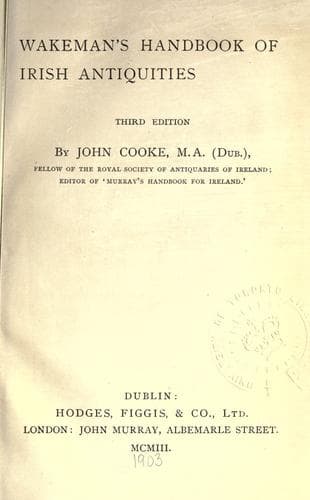
Wakeman's handbook of Irish antiquitiesWakeman, W. F. (William Frederick)
History
Wakeman's handbook of Irish antiquities
Wakeman, W. F. (William Frederick)
Ireland -- Antiquities
In several parts of the country the gallaun is still considered by
many of the people to be something weird, and, ‘to be let alone.’ The
late E. A. Conwell, in his work on the supposed tomb of Ollamh Fodhla,
points out that, about two miles north-west of Oldcastle, there is a
townland called Fearan-na-gcloch (from _fearan_, land, and _cloch_,
a stone), so called from two remarkable stone flags, still to be
seen standing in it, popularly called Clocha labartha, the ‘Speaking
stones’: and the green pasture-field in which they are situated is
called Pairc-na-gclochalabartha, the ‘Field of the speaking stones.’
‘There can be little doubt,’ he proceeds, ‘the pagan rites of
incantation and divination had been practised at these stones, as
their very name, so curiously handed down to us, imports; for, in the
traditions of the neighbourhood, it is even yet current that they have
been consulted in cases where either man or beast was supposed to
have been “overlooked”; that they were infallibly effective in curing
the consequences of the “evil eye”; and that they were deemed to be
unerring in naming the individual through whom these evil consequences
came. Even up to a period not very remote, when anything happened to be
lost or stolen, these stones were invariably consulted; and in cases
where cattle, &c., had strayed away, the directions they gave for
finding them were considered as certain to lead to the desired result.
There was one peremptory inhibition, however, to be scrupulously
observed in consulting these stones, viz. that they were _never_ to
be asked to give the same information a second time, as they, under
no circumstances whatever, would repeat an answer.’ These conditions
having, about seventy or eighty years ago, been violated by an ignorant
inquirer who came from a distance, the ‘speaking stones’ became
dumb, and have so remained ever since. There were originally four of
these stones: of the two that remain, the larger may be described as
consisting of a thin slab of laminated sandy grit. Its dimensions are
as follows: total height above ground, very nearly 7 feet; extreme
breadth, 5 feet 8 inches; breadth near summit, 3 feet 6 inches; average
thickness, about 8 inches. In no part does it exhibit the mark of a
chisel or hammer. The height of the second remaining stone, above the
present level of the ground, is 6 feet 4 inches; it is in breadth, at
base, 3 feet 4 inches, and near the top 1 foot more; thickness at base,
14 inches. The material, unlike that found in the generality of such
monuments, is blue limestone.
[Illustration: Pillar-stone at Tara.]
Public-domain text, read in full here on John Shaqi.
Reviews
Reviews
No reviews yet
Be the first to share your thoughts on this work.
Join the Discussion
Join the discussion
Sign in to leave a comment or review.
Sign InorCreate an account