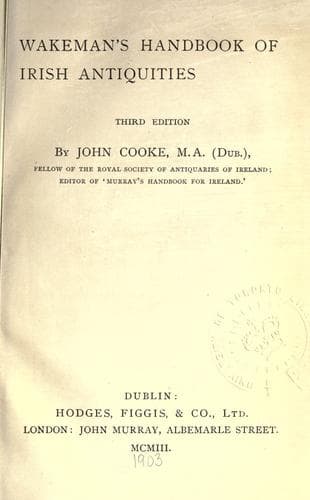
Wakeman's handbook of Irish antiquitiesWakeman, W. F. (William Frederick)
History
Wakeman's handbook of Irish antiquities
Wakeman, W. F. (William Frederick)
Ireland -- Antiquities
It is not to be supposed that all lake-dwellings are of great
antiquity; some are no doubt of much earlier date than others, but the
question of their precise age is especially complicated from the fact
that, at whatever period they were constructed, many were occupied
through a long period of historic time. Crannogs are frequently
mentioned in the Irish ‘Annals,’ and they enter into the composition
of several place-names. Many of them suffered from the attacks of
the Norsemen, as records tell us. We have clear historic evidence of
the occupation of some of the lake-dwellings throughout the Middle
Ages, and through the Elizabethan wars down to the middle of the
seventeenth century.[120] In many, as we have seen, flint cores, with
flakes, scrapers, knives, and arrow-heads, have been found. With them
sometimes occurred stone celts, exactly similar to examples found
in primitive cists, with burial urns and evidences of cremation. No
doubt crannogs yielding flint and worked stone should be regarded
as the oldest; yet from the fact that spear-heads, celts, and other
articles of bronze, and even of iron, are at times found plentifully
amongst their piling, or in the surrounding bog stuff, we must conclude
that these islets had been used by a people well skilled in the art
of metallurgy. It is necessary, too, to point out that year by year
additional evidence is produced to show that in Ireland at least the
apparently contemporaneous use of flint, stone, bone, bronze, and
iron in the preparation of weapons, implements, and ornaments for the
person, had existed throughout a long period of time. In addition to
the mixed ‘finds’ already mentioned, there were found, in a Monaghan
lake-dwelling described by Mr. Shirley, stone celts, a worked flint,
apparently intended for an arrow-head, three looped bronze celts,
a dagger and chisel of bronze, as also two bronze arrow-heads and
a shield-boss of the same metal, accompanied by iron remains. At a
place named ‘The Miracles,’ near Monea, Co. Fermanagh, in 1875, a
lake-dwelling, the remains of which Mr. Wakeman had an opportunity
of examining, was discovered by turf-cutters. Here a fairly polished
axe-head, or celt, was turned up, together with a number of articles
composed of bronze, which, from the description given by the people who
had found them, were probably fibulæ. That, during some portion of the
period of its occupation, inhabitants of this crannog were in the habit
of manufacturing objects of iron was evident, as pieces of iron slag,
quantities of wood charcoal, a well-formed crucible, sharpening-stones,
and at least two grinding-stones were found amongst the _débris_. In
the nearly-drained site of Loughavilly, the ‘Loch of the ancient tree,’
near Toppid Mountain, Co. Fermanagh, are the remains of a piled mound,
formerly an island. Here were found a stone celt and lumps of iron
slag. Traces of charcoal were abundant; but, from the softness of the
Public-domain text, read in full here on John Shaqi.
Reviews
Reviews
No reviews yet
Be the first to share your thoughts on this work.
Elsewhere in the archive
Join the Discussion
Join the discussion
Sign in to leave a comment or review.
Sign InorCreate an account