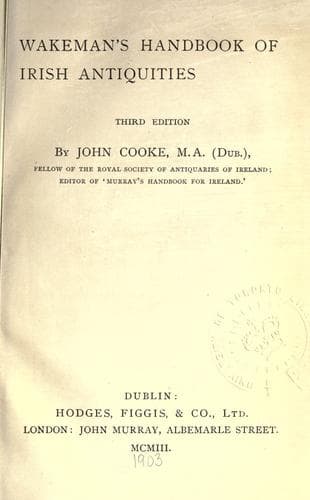
Wakeman's handbook of Irish antiquitiesWakeman, W. F. (William Frederick)
History
Wakeman's handbook of Irish antiquities
Wakeman, W. F. (William Frederick)
Ireland -- Antiquities
3. That they were designed to answer at least a twofold purpose--to
serve as belfries, and as keeps or places of strength, in which the
sacred utensils, books, relics, and other valuables were deposited, and
into which the ecclesiastics to whom they belonged could retire for
security in cases of sudden attack.
4. An examination of ancient Irish literature tends strongly to the
conclusion that the people so generally recognised this use of the
round towers as a primary one, that they very rarely applied to a tower
erected for defence any other term but that of ‘cloictheach’ or belfry.
5. That they were probably also used, when occasion required, as
beacons and watch-towers.
Petrie, while establishing their ecclesiastical character and origin,
gave, however, too wide a margin to the date of their erection, viz.,
from the sixth century to the thirteenth. The investigations of the
late Lord Dunraven in tracing such structures on the Continent narrowed
their first erection down to the ninth century. He shows that they were
founded on European examples, the most notable being those of Ravenna,
where six of its round towers still stand. The round towers were due
to Byzantine influences, and some writers trace their original source
to the towers built in connection with early Syrian churches. Miss
Stokes, following Lord Dunraven, assigns the Irish round towers to
three periods between 890 and 1238 A.D., and classifies them into four
distinct groups, according to their style of masonry and doorways.
[Illustration: Doorway, Round Tower, Glendalough.]
The Norse sea-rovers rendered ecclesiastical establishments most
unsafe. The first period of their invasions extended from the end of
the eighth century to the middle of the ninth century, and the land
was ravaged from north to south with fire and sword. On the sea-coast
and along the river valleys the country lay waste. On the banks of the
Bann, the shores of Lough Neagh, by the Boyne, and broad expansions
of the Shannon, and as far south as the distant Skellig Rock, few
sacred establishments escaped plunder and desecration. To protect their
churches, oratories, and sacred treasures, these towers were built by
the monks, from which watch could be kept, and an easy retreat made to
them as places of safety; their lines can still be traced along the
shores of the waters where the fleets of the Danes are known to have
appeared.
The usual features of the round towers may be thus summarised:
* * * * *
[Illustration: Cross over the Doorway of Antrim Tower.]
[Illustration: Doorway, Donaghmore Tower, Co. Meath.]
Public-domain text, read in full here on John Shaqi.
Reviews
Reviews
No reviews yet
Be the first to share your thoughts on this work.
Elsewhere in the archive
Join the Discussion
Join the discussion
Sign in to leave a comment or review.
Sign InorCreate an account