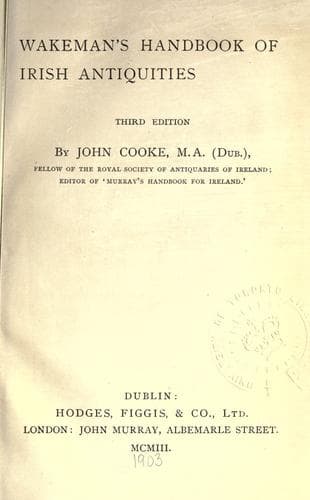
Wakeman's handbook of Irish antiquitiesWakeman, W. F. (William Frederick)
History
Wakeman's handbook of Irish antiquities
Wakeman, W. F. (William Frederick)
Ireland -- Antiquities
The fine shrine of Molaise’s Gospels in the Academy collection dates
from the first quarter of the eleventh century, and is the oldest
of the Cumdachs. The shrine of the Stowe Missal, dating a little
later, and the shrine of St. Columba’s Psalter, are also in the same
collection. A description of one example of these shrines will suffice.
The Cumdach of St. Columba’s Psalter, called the _Cathach_, or _Caha_,
and also known as the ‘Battler,’ is a box about nine inches and a half
in length, eight in breadth, and two in thickness, formed of brass
plates riveted one to the other, and ornamented with gems and chasings
in gold and silver. It was long supposed to contain the bones of
Columba; and a superstitious belief was held as to the evil befalling
him who opened it. This, however, was done by Sir William Betham, and
it was found to contain the customary rude wooden box enclosing a MS.
on vellum, consisting of fifty-eight membranes. The MS. is a copy of
the second revision of the Psalter by St. Jerome, and has been commonly
attributed to St. Columba. The sheets were found to be incomplete
and much injured: they began with the 31st and ended with the 106th
Psalm. The decoration displayed upon the top of the box shows the
comparatively late date of this portion of the relic. The top consists
of a silver plate richly gilt, and divided into three compartments by
clustered columns supporting arches. The central space is somewhat
larger than the others, and contains the figure of an ecclesiastic,
probably St. Columba, who is represented in a sitting posture, giving
the benediction, and holding a book in his left hand. The arch of this
compartment is pointed, while the others are segmental. The space to
the left of the central figure is occupied by that of a mitred abbot,
giving the benediction with his right hand, while in his left he holds
a crosier. The compartment to the right of the central figure contains
a representation of the Passion. There are figures of angels with
censers over each of the side-arches. A border, within which the whole
is enclosed, is formed at the top and bottom of a variety of fabulous
animals; the sides represent foliage, and in each angle there is a
large rock crystal. A fifth setting of crystal surrounded with smaller
gems occurs immediately over the figure, which, as we have said, was
probably intended to represent St. Columba. The sides and ends of the
box are also richly chased. An inscription in the Irish character upon
the bottom desires ‘a prayer for Cathbar Ua Domnaill, for whom this
case was made; for Sitric, son of Mac Aeda, who made it; for Domnall,
son of Robartach; for the successor of Kells, for whom it was made.’
The Domnall here referred to as ‘successor’ of St. Columba is named in
a charter, dating about 1084, in the _Book of Kells_: the end of the
eleventh century was probably, therefore, the date of the shrine.
Public-domain text, read in full here on John Shaqi.
Reviews
Reviews
No reviews yet
Be the first to share your thoughts on this work.
Elsewhere in the archive
Join the Discussion
Join the discussion
Sign in to leave a comment or review.
Sign InorCreate an account