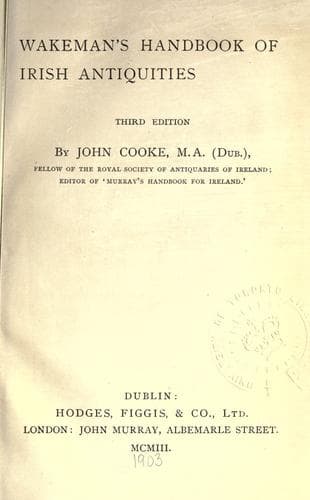
Wakeman's handbook of Irish antiquitiesWakeman, W. F. (William Frederick)
History
Wakeman's handbook of Irish antiquities
Wakeman, W. F. (William Frederick)
Ireland -- Antiquities
The holed-stone of Castledermot is a very remarkable one, and the
following particulars are from a description of it by Lord Walter
FitzGerald: ‘It stands at the head of a modern grave in the south-east
side of the churchyard, and is known locally as the “swearing-stone.”
It is 3 feet long, 1 foot 2 inches wide, and 5½ inches thick. The
hole is at the junction of the arms of a ringed cross, and measures
5 inches in diameter. The cross, which is much worn, was mistaken by
Vallancey for Ogam scores, and his misrepresentation was copied by
subsequent writers.’[9] It is probable that the holed-stones found in
connection with church buildings date from ante-Christian times, and
were consecrated by the emblem of the cross to the religious services
of a people recently won to Christianity, but who still possessed some
lingering reverence for the idols of their forefathers.
The holed-stone at Mainister on Aran Island stands 3½ feet above
ground, and the hole is 2 inches wide. It is curiously incised with a
double circle and ringed cross, the top of the latter ending in small
spiral pattern. It is held in great reverence, and small articles of
clothing of sick persons are drawn through the orifice in hope of their
recovery.
[Illustration: Holed-stone at the ‘Church of the Men,’ Inismurray.]
The following particulars of holed-stones, to which popular
superstitions are attached, are derived from _A Survey of Antiquarian
Remains in Inismurray_[10] by Mr. Wakeman. This island, off the coast
of Sligo, presents three fine specimens of the pillar-stone, two of
which must be considered valuable, and probably unique examples of
the ‘holed’ class. These are sometimes called ‘Praying stones’ by
the natives of the island. The more important stands on the southern
side of Teampull-na-bfear, or the ‘Church of the men,’ at a little
distance from that structure. It measures 4 feet in height, 11½ inches
in breadth at top, 1 foot 1 inch at base, and about 7 inches in
thickness. The monument faces east and west; its edges and eastern
side are plain. The western face, on which a graceful cross has been
incised, exhibits two holes of a size just large enough to admit the
insertion of a thumb. It may be observed that the arms and head of
the symbol terminate in spirals like those found upon the celebrated
‘Alphabet Stone’ at Kilmalkedar, the work upon which has been held, by
acknowledged authorities on such matters, to belong to the sixth, or at
latest to the seventh century of the Christian era. The orifices extend
through the adjoining angles of the stone, and open out at its sides in
apertures sufficiently spacious to receive the fingers of a full-sized
hand. In connection with this pillar-stone, as also with a similar
monument situated close to Teampull-na-mban, or ‘Church of the women,’
a custom which is worthy of record, very generally prevails. Women who
expect shortly to become mothers are wont to resort to these stones,
Public-domain text, read in full here on John Shaqi.
Reviews
Reviews
No reviews yet
Be the first to share your thoughts on this work.
Join the Discussion
Join the discussion
Sign in to leave a comment or review.
Sign InorCreate an account