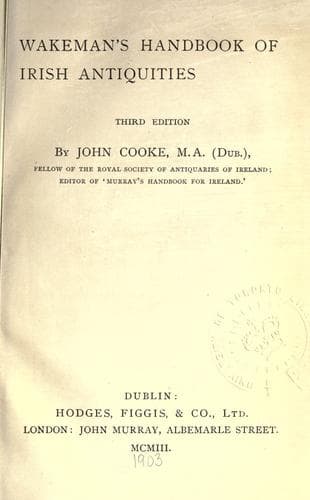
Wakeman's handbook of Irish antiquitiesWakeman, W. F. (William Frederick)
History
Wakeman's handbook of Irish antiquities
Wakeman, W. F. (William Frederick)
Ireland -- Antiquities
for the purpose of praying for a happy issue from the perils of their
impending travail. The natives assert that death in childbirth is an
unknown calamity upon the island. The postulants kneel, passing their
thumbs into the front, and their fingers into the side openings, by
which means a firm grasp of the angles of the pillar is obtained. They
are thus enabled to rise from their act of obeisance with a minimum of
strain or difficulty. A pillar-stone, unperforated and uninscribed, of
about the same dimensions as that just noticed, is seen immediately
beside it. The two stand in line at right angles with the northern wall
of the very ancient church almost immediately adjoining.
The second holed-stone, to which we have already referred, bears upon
its eastern face a plain Latin cross. It is 5 feet high, 10½ inches
broad at base, 11½ inches at top, and 4½ inches in thickness. Like its
fellow at the ‘Church of the men’ it is held in profound veneration,
especially by the women of the island. The pillar may indeed be
prehistoric, and the cross an addition. The type of cross which it
exhibits is characteristic of the earliest Christian times in Ireland;
this being so, the monument in its present style may be assigned to a
period not later than the close of the sixth century.
* * * * *
_Rock Scribings, Cup-and-Circle Markings._--This subject has proved of
considerable interest to archæologists everywhere. Rock scribings or
markings, whether noticed upon European, Asiatic, or American rocks
or monuments, often in their general features bear so strong a family
likeness that it is at first sight difficult to believe that they have
not been executed by one and the same race of people. But we know that
the minds of savages or semi-savages, situated widely apart, and placed
under somewhat similar environment, will instinctively run in parallel
grooves of thought; and thus, in the form, material, and ornamentation
of their objects of veneration, arms, and implements of everyday life,
as well as in their personal decorations, present a like development.
It need be no wonder then that, far and near, over the surface of the
Old and of the New World, rock and stone scribings are to be found, and
that they should frequently have many common characteristics. Until
recently these antiquarian puzzles have received but little attention
from Irish archæologists. Petrie does not seem to have noticed their
existence; O’Donovan and O’Curry make no mention of them; nor do
the older writers, except in one or two instances, where a single
stone or so is referred to as bearing work of a mystic and barbarous
character. The forms of these markings to be met with in Ireland are
these: cups; cups and rings; the same with radial channel; concentric
rings; penannular rings; spirals; stars; triangles and wheels; zigzag
and other lines. Considerable attention has been given in recent years
Public-domain text, read in full here on John Shaqi.
Reviews
Reviews
No reviews yet
Be the first to share your thoughts on this work.
Join the Discussion
Join the discussion
Sign in to leave a comment or review.
Sign InorCreate an account