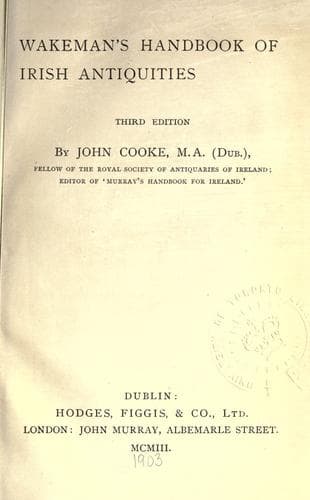
Wakeman's handbook of Irish antiquities — John Shaqi
Wakeman's handbook of Irish antiquitiesWakeman, W. F. (William Frederick)
History
Wakeman's handbook of Irish antiquities
Wakeman, W. F. (William Frederick)
Ireland -- Antiquities
that theory, particularly as it failed to account for the openings in
the circles, the absence of figures indicating the sun and moon, and
not even the rudest attempt at the phases of the lunar body. It was
also suggested that the circles were intended for moulds to cast metal
rings. The fact of the circles so often occurring on a sloping face
of a rock renders this untenable. That the circles were used for some
game was rejected from the varying sizes of the circles on different
stones. ‘The idea which occurred to my own mind,’ he continues, ‘was,
that the incised circles were intended to represent the circular
buildings of earth or stone, of which the traces still exist in
every part of Ireland. This conjecture is supported by the following
considerations:--1. The circles are of different sizes, and some are
disposed in concentric groups. The ancient dwellings and fortified
seats of the ancient Irish were circular; they were of various sizes,
from the small cloghan, or stone house, of ten feet in diameter, to the
great camp including an area of some acres; and the principal forts had
several concentric _valla_. 2. The openings in the inscribed circles
may have been intended to denote the entrances. 3. The other inscribed
lines may have represented roads passing by or leading up to the forts.’
Discouraged by the reception with which his theory was received, he
laid his drawings aside for many years. Returning again to the subject,
he gave it further examination, which confirmed his original opinion.
He says: ‘The centres of the circles and the neighbouring cups and dots
arrange themselves generally three by three in straight lines. This
disposition of the symbols could not be said to be perfectly accurate;
but I thought I could observe close and designed approximation to
it. If, then, the circles represent forts, and are disposed three by
three in straight lines on the inscribed stones, I saw that we might
expect to find the forts disposed in like manner over the surface
of the country; and I think that I have succeeded in verifying this
inference. The ancient raths have fortunately been laid down on the
six-inch Ordnance Survey maps of Ireland; and unless I am deceived by
fortuitous collineations, I find that the forts are actually arranged
three by three in straight lines. The discovery of this fact, if it be
a fact would be of much more consequence than the explanation of the
meaning of the inscriptions of which I have just given an account. But
this further inquiry must be conducted with care. Large portions of the
country must be examined, and those difficulties must be confronted
which the disappearance of ancient remains must inevitably give rise
to.’[11]
Public-domain text, read in full here on John Shaqi.
Reviews
Reviews
No reviews yet
Be the first to share your thoughts on this work.
Join the Discussion
Join the discussion
Sign in to leave a comment or review.
Sign InorCreate an account