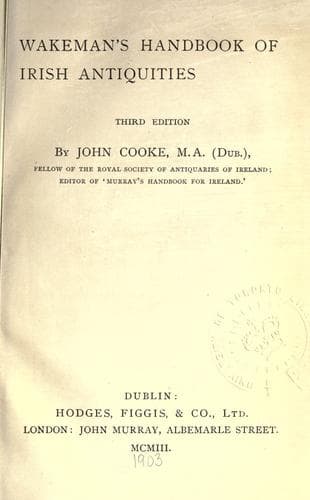
Wakeman's handbook of Irish antiquitiesWakeman, W. F. (William Frederick)
History
Wakeman's handbook of Irish antiquities
Wakeman, W. F. (William Frederick)
Ireland -- Antiquities
to the elaborate scorings on the rocks forming the great chambers at
Newgrange, Dowth, and Loughcrew, Co. Meath, to which we shall refer in
a subsequent chapter. In these ‘Ireland,’ as Colonel Wood-Martin says,
‘possesses a collection of this species of prehistoric ornamentation
which, in singularity, number, and quaintness of design, is approached
in point of interest only by some of the great stone chambers of the
district of Morbihan.’
The late Dr. Graves, Bishop of Limerick, in the publications of the
Royal Irish Academy, appears to have been the first to draw attention
to sculpturings of this class found in Ireland. Subsequently the
subject was taken up by inquirers, in various parts of the world, who
found in their own countries kindred rock carvings. In Ireland the
groups of designs found upon the surface of our undisturbed rocks
exhibit in many instances characteristics almost, if not entirely,
peculiar to themselves. For instance, the incomplete concentric
circles with a central cup, from which extends a straight or slightly
curved stroke, called ‘the channel,’ through and sometimes beyond the
outermost gap in the curved lines, are absent from the varied figurings
found in the great sepulchral chambers. Again, the spirals of the
stone sepulchres are, as far as we are aware, invariably absent in
the array of designs found upon the undisturbed or natural rock. This
circumstance was not left unobserved by Dr. Graves when describing his
discoveries in Kerry. But upon one small stone in the neighbourhood
of Tullakeel, near Sneem, he found a rude carving of a short portion
of a spiral. This stone lay set in a fence; it may have belonged to
some tomb of which no other relic is known to remain, so that little
argument can be based on the character of its scribing. Although
antiquaries are not yet in a position to pronounce authoritatively on
the precise significance of our rock markings, a glance at some early
speculations as to their nature may not here be out of place. It has
been suggested that the circular markings were intended to represent
shields. ‘This notion,’ says Dr. Graves, ‘seems inconsistent with
the fact that the same stone presents so many circular symbols of
different sizes, varying from the small shallow cup of an inch or two
in diameter to the group of concentric circles two feet across. It also
seems probable that, as shields in general used to bear distinctive
devices, these would appear in the inscriptions; but the inscribed
circles exhibit no such variety as might have been expected on this
hypothesis. Again, if the circles represented shields, what could be
meant by the openings in the circumference of so many of them? Lastly,
what connection could there be between the idea of shields and the
long lines appearing in the Staigue monument, or the short ones on
that of Ballynasare? Another idea was that these figures were designed
to represent astronomical phenomena.’ For several reasons he rejected
Public-domain text, read in full here on John Shaqi.
Reviews
Reviews
No reviews yet
Be the first to share your thoughts on this work.
Join the Discussion
Join the discussion
Sign in to leave a comment or review.
Sign InorCreate an account