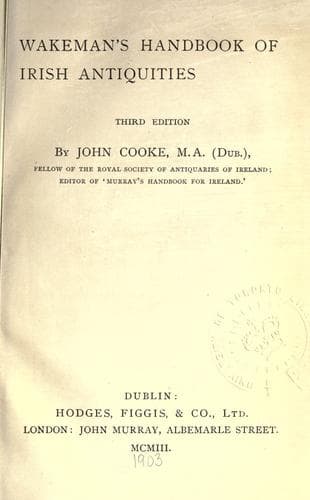
Wakeman's handbook of Irish antiquitiesWakeman, W. F. (William Frederick)
History
Wakeman's handbook of Irish antiquities
Wakeman, W. F. (William Frederick)
Ireland -- Antiquities
The idea seems to have struck Fergusson, who at least on one occasion
accompanied Conwell to the place, that the Loughcrew monuments
represented the once famous, but long-forgotten, cemetery of Taillten,
a place which was supposed to be represented by the modern Teltown,
about fifteen miles distant. After weighing the evidence in reference
to the supposed identification, Fergusson writes:--‘If, however,
this is not Taillten, no graves have been found nearer Teltown which
would at all answer to the description that remains to us of this
celebrated cemetery; and till they are found, these Loughcrew mounds
seem certainly entitled to the distinction. I cannot see that the
matter is doubtful.’[44] According to the _Annals of the Four Masters_,
numerous were the kings and nobles here buried. The first whose name
is mentioned is Ollamh Fodhla, son of Fiacha Finscothach, and founder
of the Feis at Tara. Eochaidh was his first name, and ‘he was called
Ollamh (Fodhla), because he had been first a learned Ollamh, and
afterwards king of Fodhla, _i.e._ of Ireland.’ The ‘Four Masters’ set
down his death as having occurred in 1277 B.C. The oldest and most
trustworthy authorities state that Taillten ceased to be used as a
cemetery on the death of Conchobhor, an Ultonian king, who flourished
in Erin at the commencement of the Christian era, and who, according to
the _Annals of Tighernach_, died A.D. 33.
In seventeen of the cairns sculptured stones have been found to the
number of 100. Cairn T has 28 stones with scribings, the largest number
yet noticed in any of the group. We can only briefly refer to the
contents of some of these cairns, which represent, as we have said, the
largest and most varied collection of inscribed stones hitherto found
in any Celtic monument. The largest is cairn D, which measures 180 feet
in diameter; no trace of interment has yet been found within it, and it
may have been merely monumental.
Cairn H is 5 or 6 feet high and 54 feet in diameter. Here Conway
collected 300 fragments of bones, 14 of rude pottery, 10 pieces of
flint, 155 sea-shells, and quantities of pebbles and polished stones.
But the most remarkable portion of the collection consisted of nearly
5000 pieces of bone implements, many more or less perfect, several
of which were engraved in Late Celtic pattern, as were many portions
of combs. In addition to this collection, beads of amber and glass,
bronze rings, and iron implements were found, and a recent examination
has added to these.
Public-domain text, read in full here on John Shaqi.
Reviews
Reviews
No reviews yet
Be the first to share your thoughts on this work.
Elsewhere in the archive
Join the Discussion
Join the discussion
Sign in to leave a comment or review.
Sign InorCreate an account