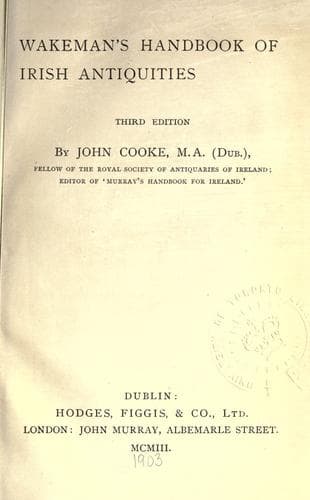
Wakeman's handbook of Irish antiquitiesWakeman, W. F. (William Frederick)
History
Wakeman's handbook of Irish antiquities
Wakeman, W. F. (William Frederick)
Ireland -- Antiquities
Under all human conditions it is necessary that some method should be
adopted for the disposal of the dead; but there can be no doubt that
the religious sentiment has ever been the predominating factor in all
burial customs. The earliest method of disposing of the dead was by
simple interment; and even when cremation became general, the practice
was never entirely abandoned. Both forms may occur in the same mound;
but the general result is that the inhumed remains are found at the
bottom, and the cremated remains nearer the surface, which shows these
were later in point of time. Where, however, the earliest interments
have been burnt bones, inhumed bodies, as at Ballon Hill, may form
secondary burials. The result of Canon Greenwell’s explorations in
the barrows of Yorkshire showed that out of 379 burials 301 were by
inhumation, and in 78 cremated remains were found. Exploration in other
parts of England gave similar results.[57] Out of 297 interments in
Derby, Stafford, and York, Mr. Bateman found that 124 were of burnt
bones; 163 were of ordinary burials, of which latter the bodies in
97 had been placed in a contracted or sitting position. Sir R. C.
Hoare found that out of 267 interments in Wiltshire, 214 were of
cremated remains, 53 of inhumed, of which the skeletons of 15 were
found contracted. In the district of Glasinac is a vast collection
of tumuli. ‘Their total number,’ says Dr. Munro, ‘is estimated at
20,000--an estimation which is now regarded as coming far short of the
actual number--of which about 1000 have been explored.... The builders
of these burial mounds practised both inhumation and cremation, the
former being in the proportion of 60 per cent., and the latter 30 per
cent., while the remaining 10 per cent. were of a mixed character,
_i.e._, contained both kinds of interments.’[58] In the Hallstatt
cemetery in the Noric Alps (which has given its name as a distinctive
term to an archæological period, owing to the importance of its
‘grave-goods’), tombs to the number of 993 were examined as far back as
1868. Of these ‘525 contained simple interments; 455 had incinerated
human remains; and in 13 the bodies had only been partially burnt
before being interred.’[59] Great quantities of implements, domestic
articles, and objects for personal use and adornment have been found in
both classes of graves.
Public-domain text, read in full here on John Shaqi.
Reviews
Reviews
No reviews yet
Be the first to share your thoughts on this work.
Elsewhere in the archive
Join the Discussion
Join the discussion
Sign in to leave a comment or review.
Sign InorCreate an account