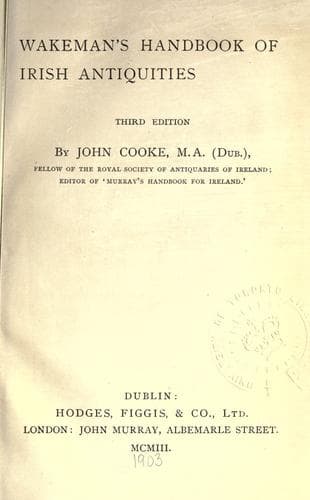
Wakeman's handbook of Irish antiquitiesWakeman, W. F. (William Frederick)
History
Wakeman's handbook of Irish antiquities
Wakeman, W. F. (William Frederick)
Ireland -- Antiquities
At Ballon Hill, near Tullow, County Carlow, a number of cinerary urns
and great quantities of cremated remains were discovered in 1853,
evidently of the pure Bronze Period. This spot has not been identified
with any of the great burial-places mentioned in early Irish records.
Three skeletons were found a couple of feet beneath an immense boulder,
‘huddled together in a small space not above 2 feet in length.’ At a
considerable depth below these, and beneath four granite blocks, a
bed of charcoal was reached, containing broken urns of four different
patterns. Many perfect urns were found, some of which are among the
finest examples yet discovered in Ireland. The urns were placed in
stone cists, and also in the earth without any trace of an enclosure.
There was evidence of great fires, while deep pits and beds of
charcoal were laid bare, showing the extent to which cremation and
the attendant funeral rites had been carried out at this spot. The
only weapon found was a single dagger blade of bronze.[60] Carrowmore
furnishes an instance of a mixed interment, where the inhumed remains
were found over the calcined bones. ‘At the lowest level,’ says Colonel
Wood-Martin, ‘of the side-stones of the cist a floor or flagging of
calpy limestone slabs was found. It was on this--which overlay the
undisturbed “till”--that the body or bodies of the primary interment
had been originally cremated, portions of the floor showing marks
of fire; and semi-burnt wood was found inlaid, with the layer of
calcined bones above. It was plainly evident from the floors and burnt
bones extending in “pockets” under the side-stones of the cist, that
the latter had been constructed over the funeral pyre, and that the
calcined remains were the primary interment, and that they had not been
placed within an already completed chamber.’[61]
In a small tumulus at Dysart, County Westmeath, Dr. Dillon Kelly
discovered, in 1876, two kistvaens containing skeletons in a contracted
position. One was of an irregular pentagon shape, the longest diameter
being 3 feet 9 inches, and the depth 2 feet 3 inches. In this there
were three animal teeth; and each chamber contained a fine urn of baked
clay. Cremated remains were found on the covering stones and round the
cists. The burning seems to have taken place over the inhumed bodies,
whose heads may, from their sitting position, have come into almost
immediate contact with the covering stones. The supposition receives
additional weight from the baked look of the tops of the skulls, both
of which presented such an appearance over the whole of their vertical
aspects.[62]
Public-domain text, read in full here on John Shaqi.
Reviews
Reviews
No reviews yet
Be the first to share your thoughts on this work.
Elsewhere in the archive
Join the Discussion
Join the discussion
Sign in to leave a comment or review.
Sign InorCreate an account