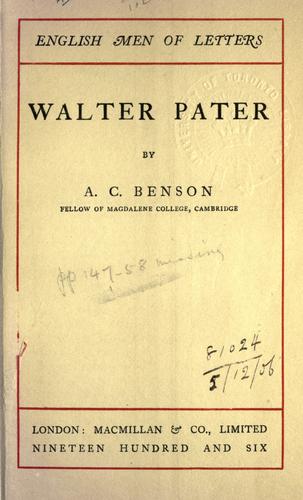
Authors, English -- 19th century -- Biography; Critics -- Great Britain -- Biography; Pater, Walter, 1839-1894
Again, though the following is probably to be regarded as legendary,
it is said that he once, in a lecture, announced that in certain
aspects we might be justified in regarding religion as a beautiful
disease. This remark was quoted by an undergraduate to his parent with
the substitution of the word “loathsome” for “beautiful.” The parent
wrote indignantly to Pater to ask if it was right that such opinions
should be expressed by a tutor to undergraduates. Pater, according to
his own account, replied that he did not think he could have used the
word “loathsome.” He might, he said, have used the word “beautiful”—“a
beautiful disease.” “The parent,” he added, “expressed himself entirely
reassured and satisfied by the explanation.”[3]
[3] The origin of this story is no doubt to be found on page 217 of
the 1889 edition of the _Appreciations_, in the suppressed essay
on “Aesthetic Poetry.” “That monastic religion of the Middle Age
was, in fact, in many of its bearings, like a beautiful disease or
disorder of the senses.”
He went to see a rather elderly game of hockey played by middle-aged
performers, and, after a moment of silence, said softly to his
companion: “Come away; I think we ought to go on; it seems hardly fair
to look at them.”
But the habit of indulging in ironical or reckless paradox had its
dangerous side. There was at Oxford in the days of Pater’s early
residence a certain aesthetic movement, a species of renaissance,
in which the creed of beauty was strongly insisted upon. In some
members of the circle that was thus affected, this resulted in much
extravagance of thought; and in some it had even worse results in
loosening the principles of morality, and judging action by the canons
of what was held to be beautiful. It is a difficult subject to treat
discreetly, because the _epigoni_ of the school, in certain notorious
instances, ended in complete moral and social shipwreck. With the
extravagances and excesses of the school it is needless to say that
Pater, a man of scrupulous conscience and a high standard of moral
delicacy, had not the slightest sympathy; but his love of paradox,
his recklessness of irony, unquestionably led him to say things which
could be unhappily distorted and misapplied, and which, not in his own
case, but in the case of those who heard and exaggerated them, were
capable of being construed in a serious light, and the utterance of
which may be said to have justified both anxiety and distress. Here, as
elsewhere, the true Pater is to be seen in his writings, and not in his
ironical _dicta_. And any careful student of his deliberate thoughts
finds no difficulty in discerning the delicacy and the loftiness of
his view. He refused, it is true, to take a conventional view of the
principles of art; but though the essential purity of art can be
distorted into a wild appetite for beautiful impressions and sensual
experience, it can yet be safeguarded and kept in a high and austere
Public-domain text, read in full here on John Shaqi.
Reviews
Reviews
No reviews yet
Be the first to share your thoughts on this work.
Elsewhere in the archive
Join the Discussion
Join the discussion
Sign in to leave a comment or review.
Sign InorCreate an account