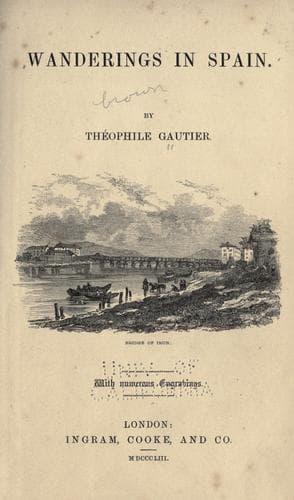
Gautier, Théophile, 1811-1872 -- Travel -- Spain; Spain -- Description and travel; Spain -- Social life and customs -- 19th century
Our passion for the Alhambra was such that, not satisfied with
visiting it every day, we were desirous of altogether taking up
our abode there; not, however, in the neighbouring houses, which
are let at very high prices to the English, but in the palace
itself; and, thanks to the interest of our Granadian friends,
the authorities, without giving us formal permission, promised
not to perceive us. We remained there four days and four nights,
which constituted, without any doubt, the happiest moments of my
existence.
In order to reach the Alhambra, we will pass, if you please,
through the square of the Vivarambla, where Gazal, the valiant
Moor, used to hunt the bull, and where the houses, with their
wooden balconies and _miradores_, present a vague appearance of so
many hen-coops. The fish-market occupies one corner of the square,
the middle of which forms an open space, surrounded with stone
seats, peopled with money-changers, vendors of alcarrazas, earthen
pots, water melons, mercery, ballads, knives, chaplets, and other
little articles that can be sold in the open air. The Zacatin,
which has preserved its picturesque name, connects the Vivarambla
with the Plaza Nueva. It is in this street, bordered by lateral
lanes, and covered with canvass _tendidos_, that all the commerce
of Granada moves and buzzes; hatters, tailors, and shoemakers,
lacemen and cloth merchants, occupy nearly all the shops, which
possess as yet nothing of the improvements of modern art, and
remind you of the old pillars of the Paris markets.
The Zacatin is always crowded. Now you meet a group of students
on a tour from Salamanca, playing the guitar, the tambourine,
castanets, and triangle, while they sing couplets full of fun and
animation; then again your eye encounters a gang of gipsy women,
with their blue flounced dresses studded with stars, their long
yellow shawls, their hair in disorder, and their necks encircled
with big coral or amber necklaces, or a file of donkeys loaded with
enormous jars, and driven by a peasant from the Vega, as sun-burnt
as an African.
The Zacatin leads into the Plaza Nueva, one side of which is
taken up by the splendid palace of the Chancellor, remarkable
for its columns of rustic order and the severe richness of its
architecture. As soon as you have crossed the place, you begin
to ascend the Calle de los Gomeres, at the end of which you find
yourself on the limits of the jurisdiction of the Alhambra, and
face to face with the Puerta de Granada, named Bib Leuxar by the
Moors, with the Vermilion Towers on its right, built, as the
learned world declares, on Phœnician sub-structures, and inhabited
at present by basket-makers and potters.
Public-domain text, read in full here on John Shaqi.
Reviews
Reviews
No reviews yet
Be the first to share your thoughts on this work.
Elsewhere in the archive
Join the Discussion
Join the discussion
Sign in to leave a comment or review.
Sign InorCreate an account