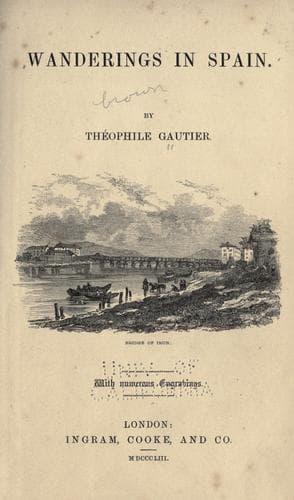
Gautier, Théophile, 1811-1872 -- Travel -- Spain; Spain -- Description and travel; Spain -- Social life and customs -- 19th century
After the soup, we had the _puchero_, an eminently Spanish dish,
or rather the only Spanish dish--for they eat it every day from
Irun to Cadiz, and reciprocally. A comfortable _puchero_ is
compounded of a quarter of veal, a piece of mutton, a fowl, some
pieces of a sausage stuffed full of pepper, and called _chorizo_,
with allspice and other spices, slices of bacon and ham, and, to
crown all, a violent tomato and saffron sauce. So much for the
animal portion. The vegetable part, called _verdura_, varies with
the season; but cabbages and _garbanzos_ always play a principal
part. The _garbanzo_ is not much known at Paris, and I cannot
define it better than "as a pea which aspires to be considered as
a haricot-bean, and succeeds but too well." All this is served up
in different dishes, and the ingredients then mixed up on your
plate, so as to produce a _Mayonnaise_ of a complicated description
and excellent flavour. This mixture will appear rather barbarous
to those connoisseurs who read Carême, Brillat-Savarin, Grimat
de la Reynière, and Mons. de Cussy; it has, however, its charm,
and cannot fail to please the Eclectics and Pantheists. Next come
fowls cooked in oil, for butter is an article unknown in Spain;
trout or salt cod, roasted lamb, asparagus, and salad; and, for
dessert, little macaroons, almonds browned in a frying-pan, and of
a most delicious taste, with goats'-milk cheese, _queso de Burgos_,
which enjoys a high reputation, that it sometimes deserves. As
a finish, they bring you a set of bottles with Malaga, sherry,
brandy, _aguardiente_, resembling French aniseed, and a little cup
(_fuego_) filled with live cinders to light the cigarettes. Such,
with a few trifling variations, is the invariable meal in all Spain.
We left Astigarraga in the middle of the night. As there was no
moon, there is naturally a gap in our account. We passed through
the small town of Ernani, the name of which conjures up the most
romantic recollections; but we did not perceive aught save a
heap of huts and rubbish vaguely sketched on the obscurity. We
traversed Tolosa without stopping. We saw some houses decorated
with frescoes, and gigantic blazons sculptured in stone. It was
market-day, and the market-place was covered with asses, mules,
picturesquely harnessed, and peasants of singular and wild
appearance.
By dint of ascending and descending, of passing over torrents on
bridges of uncemented stone, we at last reached Vergara, where we
were to dine. We experienced a decided degree of satisfaction on
our arrival, for we had almost forgotten the _jicara de chocolate_,
which we had gulped down, half asleep, in the inn at Astigarraga.
CHAPTER III.
FROM VERGARA TO BURGOS.
Vergara--Vittoria; the Baile National and the French
Hercules--The Passage of Pancorbo--The Asses and the
Greyhounds--Burgos--A Spanish Fonda--Galley Slaves in Cloaks--The
Cathedral--The Coffer of the Cid.
Public-domain text, read in full here on John Shaqi.
Reviews
Reviews
No reviews yet
Be the first to share your thoughts on this work.
Join the Discussion
Join the discussion
Sign in to leave a comment or review.
Sign InorCreate an account