Gautier, Théophile, 1811-1872 -- Travel -- Spain; Spain -- Description and travel; Spain -- Social life and customs -- 19th century
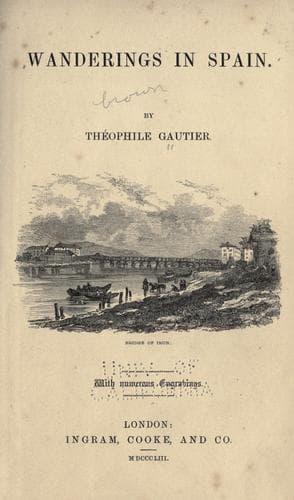
The entrance to Ecija is rather picturesque. You pass over a
bridge, at the end of which is a gateway like a triumphal arch.
This bridge is thrown over a river, which is no other than the
Genil of Granada, and which is obstructed by ancient arches and
milldams. When you have passed the bridge, you find yourself
in an open square, planted with trees, and ornamented with two
rather strange monuments. The first is a gilt statue of the Holy
Virgin, placed upon a column, the pedestal of which evidently
forms a kind of chapel, decorated with pots of artificial flowers,
votive offerings, crowns formed of the pith of rushes, and all the
other gewgaws of Meridional devotion. The second is a gigantic
Saint Christopher, also of gilt metal, with his hand resting
upon a palm-tree, a sort of walking-stick in keeping with his
immense size; on his shoulder he bears, with the most prodigious
contraction of all his muscles, and with as great an effort as if
he were raising a house, an exceedingly small infant Jesus, of
the most delicate and charming style. This colossus, said to be
the work of the Florentine sculptor, Torregiano, who flattened,
with a blow of his fist, Michael Angelo's nose, is stuck upon a
Solomonic column (as wreathed columns are here called) of light,
rose-coloured granite, the spiral wreaths of which end half-way up
in a mass of volutes and extravagant flower-work. I am very partial
to statues placed in this position; they produce a greater effect,
and are seen advantageously at a longer distance. The ordinary
pedestals have a kind of flat, massive look, which takes away from
the lightness of the figures which they support.
Although Ecija lies out of the ordinary route of tourists, and is
generally but little known, it is a very interesting town, and
very original and peculiar in its appearance. The spires which
form the sharper angles in its outline are neither Byzantine, nor
Gothic, nor in the Renaissance style; they are Chinese, or rather
Japanese, and you might easily mistake them for the turrets of some
_miao_ dedicated to Kong-fu-Tzee, Buddha, or Fo; for the walls are
entirely covered with porcelain tiles of the most vivid tints,
while the roofs are formed of varnished white and green tiles,
arranged like the squares of a chessboard, and presenting one of
the most curious sights in the world. The rest of the buildings are
not less chimerical. The love of distorted lines is carried to the
utmost possible lengths. You see nothing but gilding, incrustation,
breccia, and various-coloured marbles, rumpled about as if they
were cloth and not stone, garlands of flowers, lovers'-knots, and
bloated angels, all coloured and painted in the most profuse manner
and sublime bad taste.
Public-domain text, read in full here on John Shaqi.
Reviews
Reviews
No reviews yet
Be the first to share your thoughts on this work.
Elsewhere in the archive
Join the Discussion
Join the discussion
Sign in to leave a comment or review.
Sign InorCreate an account