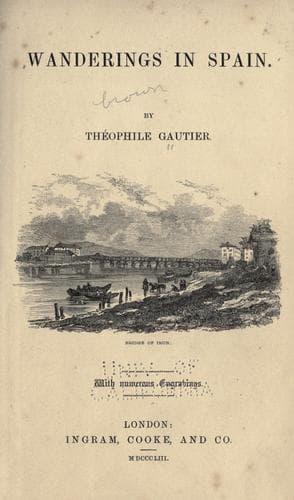
Gautier, Théophile, 1811-1872 -- Travel -- Spain; Spain -- Description and travel; Spain -- Social life and customs -- 19th century
The _Calle de los Caballeros_, where the nobility reside and the
finest mansions are situated, is truly a miraculous specimen of
this style: you have some difficulty in believing that you are
in a real street, between houses that are inhabited by ordinary
human beings. Nothing is straight, neither the balconies, the
railings, nor the friezes; everything is twisted and tortured all
sorts of ways, and ornamented with a profusion of flowers and
volutes. You could not find a single square inch which is not
guilloched, festooned, gilt, carved, or painted; the whole place
is a most harsh and extravagant specimen of the style termed in
France _rococo_, and presents a crowding together of ornament
that French good taste, even during its most depraved epochs,
has always successfully avoided. This Pompadour-Dutch-Chinese
style of architecture amuses and surprises you in Andalusia. The
common houses are whitewashed, and their dazzling walls stand out
wonderfully from the deep azure of the sky, while their flat roofs,
little windows, and _miradores_, reminded us of Africa, which was
already sufficiently suggested to our minds by thirty-seven degrees
of Réaumur, which is the customary temperature of the place during
a cool summer. Ecija is called the Stove of Andalusia, and never
was a surname more richly merited. The town is situated in a basin,
and surrounded by sandy hills which shield it from the wind, and
reflect the sun's rays like so many concentric mirrors. Every one
in the place is absolutely fried, but this did not prevent us from
walking about all over it while our breakfast was being prepared.
The _Plaza Mayor_ has a very original look, with its pillared
houses, its long rows of windows, its arcades, and its projecting
balconies.
Our _parador_ was tolerably comfortable; they gave us a meal that
was almost human, and we partook of it with a degree of sensuality
very allowable after so many privations. A long siesta, in a large
room, carefully shut up, very dark, and well watered, completely
restored us; and when, about three o'clock, we again got into the
_galera_, it was with a quiet air of perfect resignation that we
did so.
The road from Ecija to La Carlotta, where we were to pass the
night, traverses a very uninteresting country, which appeared to
be arid and dusty, or at least the season gave it that look; it
has not left any very remarkable impression on my mind. A few
olive plantations and clumps of oak-trees appeared from time to
time, and the aloes displayed their bluish foliage which is always
so characteristic. The dog belonging to the superintendent of
mines (for, besides the children, we had some quadrupeds in our
menagerie) started a few partridges, two or three of which were
brought down by my companion. This was the most remarkable event
during this stage.
Public-domain text, read in full here on John Shaqi.
Reviews
Reviews
No reviews yet
Be the first to share your thoughts on this work.
Elsewhere in the archive
Join the Discussion
Join the discussion
Sign in to leave a comment or review.
Sign InorCreate an account