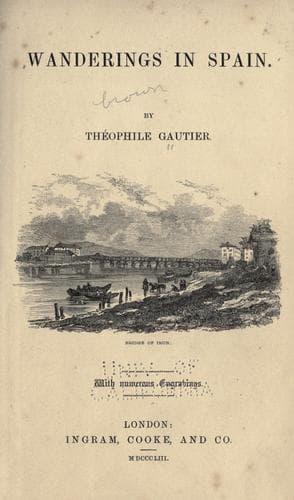
Gautier, Théophile, 1811-1872 -- Travel -- Spain; Spain -- Description and travel; Spain -- Social life and customs -- 19th century
religious Titans, as it were, who heaped Pelion on Ossa, not to
dethrone the Deity they adored, but to admire more closely the mild
countenance of the Virgin-Mother smiling on the Infant Jesus. In
our days, when everything is sacrificed to some gross and stupid
idea or other of comfort, people no longer understand these sublime
yearnings of the soul towards the Infinite, which were rendered
by steeples, spires, bell-turrets, and ogives, stretching their
arms of stone heavenwards, and joining them, above the heads of
the kneeling crowd, like gigantic hands clasped in an attitude of
supplication. Political economists shrug their shoulders with pity
at all these treasures lying idle without returning anything. Even
the people are beginning to calculate how much the gold of the pyx
is worth: they who once scarcely dared to raise their eyes on the
white sun of the host, whisper to themselves that pieces of glass
would do quite as well to decorate the monstrance as the diamonds
and precious stones; the church is, at present, hardly frequented
by any one save travellers, beggars, and horrible old hags,
atrocious dueñas clad in black, with owl-like looks, death's-head
smiles, and spider hands, who never move without a rattling, as
if of rusty bones, medals and chaplets, and, under pretence of
soliciting arms, murmur atrocious propositions concerning raven
tresses, rosy complexions, burning glances and ever-budding smiles.
Spain itself is no longer Catholic!
The Giralda, which serves as a campanila to the cathedral, and
rises above all the spires of the town, is an old Moorish tower,
erected by an Arabian architect, named Geber or Guever, who
invented algebra, which was called after him. The appearance of
the tower is charming and very original; the rose-coloured bricks
and the white stone of which it is built, give it an air of gaiety
and youth, which forms a strange contrast with the date of its
erection, which extends as far back as the year 1000, a very
respectable age, at which a tower may well be allowed to have a
wrinkle or two, and be excused for not being remarkable for a
fresh complexion. The Giralda, in its present state, is not less
than three hundred and fifty feet high, while each side is fifty
feet broad. Up to a certain height the walls are perfectly even;
there are then rows of Moorish windows with balconies, trefoils,
and small white marble columns, surrounded by large lozenge-shaped
brick panels. The tower formerly ended in a roof of variously
coloured varnished tiles, on which was an iron bar, ornamented with
four gilt metal balls of a prodigious size. This roof was removed
in 1568, by the architect, Francisco Ruiz, who raised the daughter
of the Moor Guever, one hundred feet higher in the pure light of
heaven, so that his bronze statue might overlook the sierras, and
speak with the angels who passed. The feat of building a belfry on
a tower was in perfect keeping with the intentions of the members
Public-domain text, read in full here on John Shaqi.
Reviews
Reviews
No reviews yet
Be the first to share your thoughts on this work.
Elsewhere in the archive
Join the Discussion
Join the discussion
Sign in to leave a comment or review.
Sign InorCreate an account