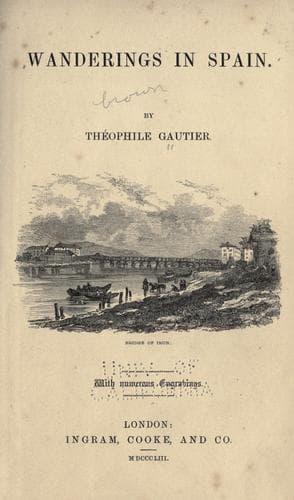
Gautier, Théophile, 1811-1872 -- Travel -- Spain; Spain -- Description and travel; Spain -- Social life and customs -- 19th century
I shall pass very rapidly over the first few posts, which possess
nothing worthy of observation. Right and left stretch all kinds
of crops, streaked like tiger or zebra skins, and bearing a most
satisfactory resemblance to a tailor's book, in which are pasted
his various specimens of trowsers and waistcoat patterns. Although
these kinds of views are productive of great delight to farmers,
landlords, and other worthies of a similar stamp, they afford but
meagre entertainment to the enthusiastic and graphic traveller,
who, spy-glass in hand, sets out to note the peculiarities of the
universe in the same manner as a police agent does those of an
individual. Having left Paris in the evening, my first impressions,
after passing Versailles, are but so many feeble sketches _stumped
in_ by the hand of Night. I regret that I passed through Chartres
without being able to see its cathedral.
Between Vendôme and Château-Regnault, which is pronounced _Chtrnô_
in the language of the postilions, so well imitated by Henri
Monnier in his sketch of the "Diligence," there rise a number of
well-wooded hills, where the inhabitants dig their houses out of
the living rock, and live under ground, after the fashion of the
ancient Troglodytes. The stone obtained from these excavations
they sell, so that each house thus scooped out produces another
_en relief_, like a plaster figure taken out of a mould, or a
tower dragged out of a well. The chimney, which is a long passage
hammered through the rock, ends at the surface, so that the smoke
ascends from the ground itself in bluish spirals, and without any
visible cause, exactly as if it proceeded from a sulphur mine, or
from some volcano. A facetious traveller would not experience the
slightest difficulty in throwing stones into the omelets of this
cryptic population, and the rabbits, if they are ever absent or
short-sighted, must certainly fall, very often, all alive, into the
saucepans. By constructing houses on this principle, the trouble of
going down into the cellar to fetch your wine is entirely avoided.
Château-Regnault is a small town built upon a number of serpentine
and rapid declivities, bordered by ill-pitched and tottering
houses, which appear to lean against one another to keep themselves
upright. A large round tower, situated upon the talus of some old
fortifications, enveloped here and there in green patches of ivy,
redeems, to a certain extent, the appearance of the town. From
Château-Regnault to Tours there is nothing remarkable. Earth in the
middle, and trees on each side, forming those long yellow bands,
which lose themselves in the distance, and which, in the language
of the wagoners, are termed _rubans de queue_, are all that is to
be seen: then, on a sudden, the road dives down a couple of pretty
steep hills, and in a few minutes you perceive the town of Tours,
rendered famous by its prunes, Rabelais, and de Balzac.
Public-domain text, read in full here on John Shaqi.
Reviews
Reviews
No reviews yet
Be the first to share your thoughts on this work.
Join the Discussion
Join the discussion
Sign in to leave a comment or review.
Sign InorCreate an account