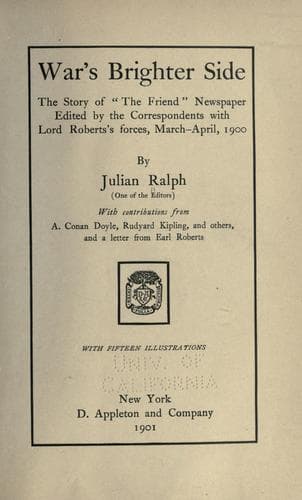
War's Brighter Side: The Story of The Friend Newspaper Edited by the Correspondents with Lord Roberts's Forces, March-April, 1900 — John Shaqi
War's Brighter Side: The Story of The Friend Newspaper Edited by the Correspondents with Lord Roberts's Forces, March-April, 1900Ralph, Julian
History
War's Brighter Side: The Story of The Friend Newspaper Edited by the Correspondents with Lord Roberts's Forces, March-April, 1900
Ralph, Julian
Friend (Bloemfontein, South Africa); South African War, 1899-1902 -- Periodicals
With such ill-chosen, mistaken men had we undergone experiences, and
now, at last, we met with Lord Stanley, who had the most intense likes
and dislikes for those around him, yet never let these hinder or
temper his unvarying fairness; who was as firm as iron and yet always
gentle; a stout, strong, stalwart man in build, hearty and kindly in
manner; a man who took command as easily and exercised it as smoothly
as if he had been a general at birth.
I speak of him at some length not merely because his case proves that
the one well-equipped censor appointed in the armies on the west side
of the continent was a civilian, and not only because this one
competent censor gave equally complete satisfaction to both the Army
and the Press, but because he assumed a conspicuous and important part
in the story I am telling.
His office was as nearly literally a hole in a wall as a room in a
house could well be. It was in the corner of the Free State Post
Office building, facing the great central square of dirt, in the
middle of which stood the market, under whose open shed the mounted
men of the City Imperial Volunteers lived among their saddles and
bridles, and slept on the tables of the greengrocers, whose place this
once had been. On the Post Office side of the square was the Free
State Hotel, the best in the town. On the opposite side, an eighth of
a mile away, was the Club. Between the two ends ran a double row of
such shops as one looks for in a small village, and behind one of
these was the office of a newspaper called _The Friend of the Free
State_.
Lord Stanley's office was a wretched poke-hole of a room. It boasted a
door with glass panels and no window. Its floor was of bare boards.
Its walls were partly made of soiled plaster and partly of bare
boards. Opposite the door, in the corner, stood a kitchen table which
was never used, and in the other dark end of the room was another
kitchen table, behind which, on a kitchen chair, the ex-Guardsman and
Whip of the Unionist Party sat nearly all day, and some hours of every
evening, with one hand full of manuscript and the other holding the
little triangular stamp with which he printed the sign manual of his
approval upon nearly every despatch which was written by those
correspondents who kept within the law governing the cabling of news
to their journals. A kerosene lamp, an inkpot and pen, and a litter of
papers were the other appointments of the room. The censor was clad in
khaki like all the rest of us, but the collar of his tunic bore on
each side the short bit of red cloth which marked him as a staff
officer.
To this office, at the censor's invitation, came Perceval Landon,
correspondent of the _Times_, H. A. Gwynne, of Reuter's Agency, F. W.
Buxton, of the _Johannesburg Star_, and myself.
Public-domain text, read in full here on John Shaqi.
Reviews
Reviews
No reviews yet
Be the first to share your thoughts on this work.
Join the Discussion
Join the discussion
Sign in to leave a comment or review.
Sign InorCreate an account