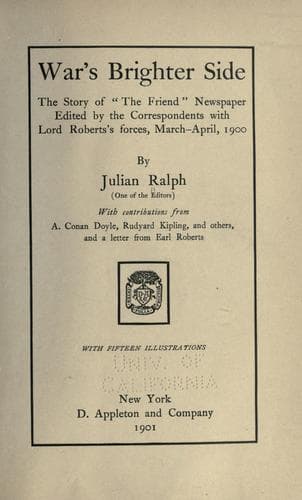
War's Brighter Side: The Story of The Friend Newspaper Edited by the Correspondents with Lord Roberts's Forces, March-April, 1900 — John Shaqi
War's Brighter Side: The Story of The Friend Newspaper Edited by the Correspondents with Lord Roberts's Forces, March-April, 1900Ralph, Julian
History
War's Brighter Side: The Story of The Friend Newspaper Edited by the Correspondents with Lord Roberts's Forces, March-April, 1900
Ralph, Julian
Friend (Bloemfontein, South Africa); South African War, 1899-1902 -- Periodicals
"Gentlemen," said Lord Stanley after the door had been closed and
locked to keep out the current of "Tommies" with telegrams which
flowed in and eddied before the desk all day, "Lord Roberts wants to
have a daily newspaper published for the entertainment and information
of the Army while we are here. I may tell you that we are likely to
stay here four weeks. You four are asked to undertake the work of
bringing out the newspaper. Will you do it?"
Three of us did not clearly see how we could undertake so laborious
and exacting a task and still do justice to our newspapers at home;
nevertheless, the censor's words had been, "Lord Roberts wants this."
"We must do it if Lord Roberts desires it," was the reply of one of
us. The rest nodded acquiescence, but said nothing.
"I am very glad," the censor replied.
Mr. Buxton, who knew South Africa and its Press very well, appeared to
have devoted some attention to the matter earlier in the day. From him
and from the censor we learned that two daily newspapers had been
published in Bloemfontein up to the time that we took possession of
the town. One was the _Express_, the property of the widow of one
Borckenhagen--a Boer organ of the most pronounced type, and notorious
for the virulence of its attacks upon the British, for its lying
reports, and its mischievous influence. That paper had been stopped by
Lord Roberts, and its machinery, type, and all else belonging to it
were for us to do with as we pleased.
The other paper was the little _Friend of the Free State_, owned, as I
understand, by an Englishman named Barlow, who was out of the country
and had left the property in the care of his son. This younger Barlow
had not conducted the paper in such a spirit toward us as one would
have looked for from a man of English blood; but, either for good
cause, worldly interests, or wholly despicable reasons, there was so
much disloyalty and so much more of fence straddling throughout South
Africa that a very lenient view was taken of this case, and we were
asked to find out what sum of money would satisfy Barlow for the loss
of income from his paper while we conducted it. He was to be told
that he could not be permitted to continue his editorship, and that
therefore it was necessary to settle on some figure covering any
shrinkage that might occur in his customary profits while the
newspaper was in our charge.
Mr. Buxton was appointed to confer with Barlow, and in a few hours we
all met again to hear that the dethroned editor would be satisfied
with a guarantee of L200, or L50 a week during the month of our
editorship.
Mr. Landon had already approached Mr. Gwynne and myself with a
proposition that we should offer to make good any losses that might
occur during our management; but other ideas prevailed.
"No," said the censor, "you cannot be allowed to lose anything by your
kindness. Two hundred pounds will be the utmost cost, eh? Well, I
think that Westminster, Dudley, and I, can raise that between us."
Public-domain text, read in full here on John Shaqi.
Reviews
Reviews
No reviews yet
Be the first to share your thoughts on this work.
Join the Discussion
Join the discussion
Sign in to leave a comment or review.
Sign InorCreate an account