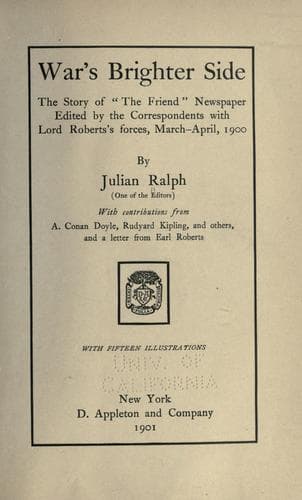
War's Brighter Side: The Story of The Friend Newspaper Edited by the Correspondents with Lord Roberts's Forces, March-April, 1900Ralph, Julian
History
War's Brighter Side: The Story of The Friend Newspaper Edited by the Correspondents with Lord Roberts's Forces, March-April, 1900
Ralph, Julian
Friend (Bloemfontein, South Africa); South African War, 1899-1902 -- Periodicals
We held our breaths for a moment as he said this, for it flashed upon
us that the heir of Lord Derby, the owner of the great Dudley estates,
and the greatest landlord of London, were to be our backers, that they
were high up among the richest men of England, and that one of them
was saying he was hopeful that among all three two hundred pounds
might not prove an impossible sum to raise.
"Yes, that's all right," Lord Stanley repeated; "I think that Dudley,
Westminster, and I can manage it."
The reader will not be prepared to hear that anything funnier than
that could grow out of this situation. But it was to be so. Weeks
after our singular editorial experience ended I received, while in
Capetown, a letter from an interested Afrikander asking me whether I
thought the three men who guaranteed Barlow against a loss of profits
from his paper were responsible men, and Barlow would be likely to get
his money.
I went away to nurse my injured leg, and the other editors went their
ways to arrange for getting out a new paper, which all of us agreed
should be christened with the now historic name of THE FRIEND. While
we are thus separated from them let me draw a pen picture of each.
Perceval Landon, representing the _Times_, is a university man, who
has been admitted to the bar, and who took up the work of a war
correspondent from an Englishman's love of adventure, danger, and
excitement. It can be nothing but his English blood that prompted him
to this course, for in mind and temperament, tastes and
qualifications, he is at once a scholar and a poet rather than a man
of violent action. Had the _Times_ so desired he would have charmed
the public with letters from the front as human and picturesque in
subject and treatment as any that were sent to London. His charms of
manner and of mind caused his companionship to be sought by the most
distinguished and the most polished men in the army, and all were
deeply sorry when, at the close of the army's stay in Bloemfontein,
illness forced him to return to London, though not until he had served
in the war as long as any man at that time on the west side of the
continent.
Public-domain text, read in full here on John Shaqi.
Reviews
Reviews
No reviews yet
Be the first to share your thoughts on this work.
Join the Discussion
Join the discussion
Sign in to leave a comment or review.
Sign InorCreate an account