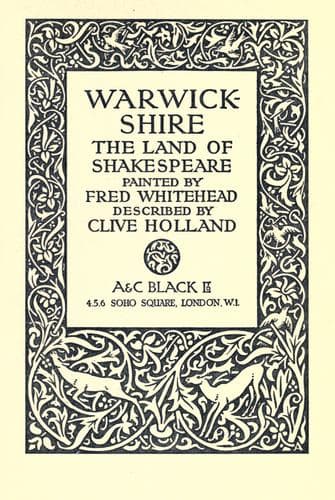
Warwickshire: The Land of ShakespeareHolland, Clive
History
Warwickshire: The Land of Shakespeare
Holland, Clive
Warwickshire (England) -- Description and travel
In the several massacres of the Danes which took place during the
period comprised by the last few years of the tenth and first years
of the eleventh centuries, the part played by Mercia, and, as a
consequence, by the district afterwards to be known as Warwickshire,
was considerable. The ultimate vengeance for these massacres, which was
taken by Swend in 1013, was shared by the Mercians as well as by the
other inhabitants of East Anglia and central England. And the coming
of Canute three years later was destined to have a far–reaching effect
upon the history of the district, and of England generally.
Arriving with his army and Eadric, the Saxon Earldorman, who had
betrayed his fellow–countrymen previously, and had, so the Chronicles
state, fled from England to escape their vengeance, Canute crossed the
Thames at Cricklade and entered and ravaged Mercia, proceeding into
Warwickshire during mid–winter’s tide, where the Danes ravaged and
burned and slew all that they could come across. Afterwards Canute and
his forces besieged London. “But,” says the Chronicler, “Almighty God
saved it.” Failing to capture the city, the Danes once more returned
into Mercia, and carried fire and sword into its vales and woodlands,
slaying and burning whatever they overran.
On the death of Æthelred the Unready two years later, in 1016, Canute
was chosen king at Southampton, and Edmund, surnamed Ironside, in
London. The latter’s reign was short but glorious; several battles were
fought with the Danes and victories won, in consequence of which Canute
agreed to a division of the kingdom between Edmund and himself. In this
division Canute took Mercia and Northumbria, and Edmund the rest of
England. In a few months the latter died in London, and Canute became
by common consent King of England.
The Danish leader’s reign brought peace and a large degree of
prosperity for the people over whom he had been destined to rule. And
during his sovereignty Warwickshire at least experienced immunity from
ravishment by fire and sword, and enjoyed a measure of good government.
In the years which immediately followed little happened to disturb
the peace of the county, although bloody feuds occasionally wrought
destruction in contiguous localities.
With the death of Edward the Confessor a brief period of unrest ensued,
whilst Harold was engaged in a struggle to retain the throne he had
ascended and in resisting the invasion of William of Normandy, who
claimed that the crown of England had been left him by Edward the
Confessor.
In the fierce Battle of Hastings, waged on the heights of Sussex,
Harold fell fighting, and with him ended the history of the country
under its Anglo–Saxon kings.
Under them England had gained a foretaste of those principles of
individual and personal liberty, in comparison with which all other
so–called freedom can be but a mockery.
Public-domain text, read in full here on John Shaqi.
Reviews
Reviews
No reviews yet
Be the first to share your thoughts on this work.
Join the Discussion
Join the discussion
Sign in to leave a comment or review.
Sign InorCreate an account