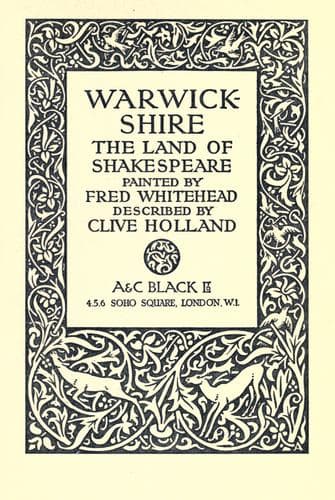
Warwickshire: The Land of Shakespeare — John Shaqi
Warwickshire: The Land of ShakespeareHolland, Clive
History
Warwickshire: The Land of Shakespeare
Holland, Clive
Warwickshire (England) -- Description and travel
The extent of the occupation of Warwickshire by the Saxons can be
easily traced by the curious from the number of _marks_, as their early
settlements were called. Thirty–one of the large number of thirteen
hundred and twenty–nine names of settlements, which have been traced
throughout the land, belong to Warwickshire. Some few of the most
notable were Leamingas (Leamington), Beormingas (Birmingham), Ludingas
(Luddington), Whittingas (Whittington), Poeccingas (Packington),
Ælmingas (Almington), Secingas (Seckington), and Eardingas (Erdington).
Warwickshire is not possessed of many Saxon remains. Of architecture
dating from before the Conquest the fragments of round–headed door
cases at Kenilworth, Stretton–on–Dunsmoor, Ryton, Honingham, Badgeley,
and Burton Dassett may be mentioned. While at Polesworth nunnery, the
ruins of Merevale Abbey, and in the churches at Salford Priors and
Beaudesert there are some fragments. Occasionally Saxon jewels have
been turned up in the soil. Perhaps amongst the most interesting of
these relics are the two Saxon jewels of cut gold, one set with an opal
and rubies, and the other adorned on both sides with a cross between
two rudely–fashioned human figures, each holding a lance or sword in
one hand, found more than a century and a quarter ago at Walton Hall,
near Compton Verney. Tumuli, of course, exist in different parts of the
country, from which at various times bones, skulls, and small ornaments
have been excavated.
Until the coming of William the Conqueror Warwickshire was almost
without historians or records, although an attempt at a survey and the
accumulation of historical data had been made in the previous reign of
Edward the Confessor. Though the Saxon Chronicle gives many interesting
and valuable details concerning lands, places, and incidentally also
of the life of the people of the period, it is to the Domesday Book,
that monumental work of the Conqueror, all historians and students have
to go when in search of information regarding the English counties at
the time of, immediately prior to, and after the Conquest. The value
of this truly wonderful work as regards Warwickshire in particular is
considerably enhanced by reason of its containing a comparative report
of the nature, extent, and value of the different estates, names of
towns, and position of roads in the reign of Edward the Confessor.
From its pages one is enabled to gain a more or less vivid idea of the
extent of the county, its inhabitants, and its peculiarities at a time
when English history and that of Warwickshire was in the making.
Public-domain text, read in full here on John Shaqi.
Reviews
Reviews
No reviews yet
Be the first to share your thoughts on this work.
Join the Discussion
Join the discussion
Sign in to leave a comment or review.
Sign InorCreate an account