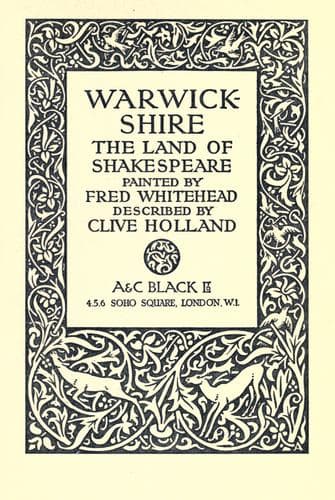
Warwickshire: The Land of ShakespeareHolland, Clive
History
Warwickshire: The Land of Shakespeare
Holland, Clive
Warwickshire (England) -- Description and travel
In this wonderful work, commenced in 1081 and completed in 1086, are
to be found records of all the original Saxon landowners (many of whom
were afterwards dispossessed by their conquerors), and the value and
extent of their estates. The original holders of the Saxon manors and
estates in Warwickshire suffered severely at the hands of the Norman
invader; and the pages of the Domesday Book afford interesting evidence
of how wide–spread these confiscations were. The population of the
county at that time was a few less than seven thousand, all told.
The period immediately succeeding the Conquest was one of great
suffering for the vanquished. Year after year the Saxon Chronicle sets
down a tale of wars, pestilences, storms, and famines, and although
there is no direct reference to Warwickshire, it is certain that the
county bore its part in “the sufferings inflicted by the acts of
tyrannous man and the wisdom of God.”
From the tangle of the history of this period it is no easy task to
seek to justly estimate the part played by Warwickshire in the history
of the country at large.
But towards the end of Henry III.’s reign it was the scene of some
of the most stirring and momentous episodes of the Barons’ War. The
struggle between the King and the Barons under the leadership of Simon
de Montfort, Earl of Leicester, centred, so far as Warwickshire was
concerned, round Kenilworth and Warwick. De Montfort at the outset of
the war garrisoned the former castle and placed Sir John Gifford in
command. The latter and the troops of the garrison promptly ravaged
the country round about, destroying the manor–houses and farms of
those who were well–affected to the King. And finding that the Earl of
Warwick had espoused the Royal cause the Kenilworth garrison, under the
leadership of its governor, surprised and made a vigorous attack upon
Warwick, taking the Earl and Countess prisoners.
In the year following the Battle of Lewes was fought, on May 14, 1264,
in which the Barons under De Montfort were victorious. Prince Edward
and his troops afterwards made a forced march and appeared before
Kenilworth and routed De Montfort and dispersed his force. De Montfort
took refuge in the castle, and ultimately effected his escape. With the
small force at his command Prince Edward felt unable to successfully
attack a fortress of such strength, but in a skirmish hard by he
succeeded in capturing much booty, and no less than fifteen of the
Barons’ standards, which were destined a short time later to prove of
peculiar service to the victor.
[Illustration: COUGHTON COURT.]
Public-domain text, read in full here on John Shaqi.
Reviews
Reviews
No reviews yet
Be the first to share your thoughts on this work.
Join the Discussion
Join the discussion
Sign in to leave a comment or review.
Sign InorCreate an account