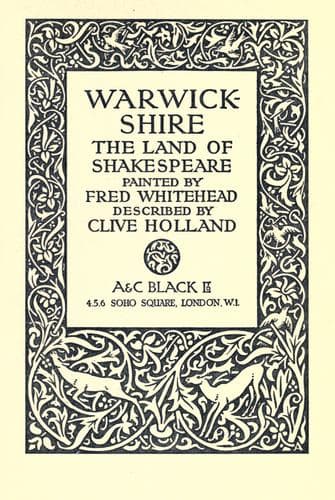
Warwickshire: The Land of Shakespeare — John Shaqi
Warwickshire: The Land of ShakespeareHolland, Clive
History
Warwickshire: The Land of Shakespeare
Holland, Clive
Warwickshire (England) -- Description and travel
At this hour of the day, although the Parliamentary left was crumpled
up and forced back, the right wing held its own, as did also the
centre; and when Rupert returned from his impetuous pursuit, it was
too late to retrieve his error of judgment. The enemy’s centre had not
only stood firm but had advanced, forcing the Royalists to retreat. The
arrival of John Hampden, with a body of troops who promptly opened fire
upon the Prince’s horsemen, causing them to flee in great confusion,
completed the disaster, Rupert himself having to throw away his hat and
plumes lest they should offer a mark to the enemy’s musketeers.
The Royal army was now indeed, for some considerable time, in imminent
danger of a disastrous and crushing defeat, owing to the severe
pressure on its left front.
Both armies suffered severely, almost equally so, states a contemporary
account, but inasmuch as the Parliamentarians had held their ground
and the Royalists had been compelled to retire from the assault, the
advantage was with some justness claimed by the former. The number of
killed was very large, but contemporary estimates are so contradictory
that it is almost impossible to obtain figures of any exactness.
Probably Sir William Dugdale, who, present during the engagement,
afterwards went over the field and estimated the number of those
actually slain to have been rather more than 1100, is approximately
correct.
Although the enclosures have altered the general appearance of the
field of battle from that which it bore on that disastrous Sunday of
October 23, 1642, the main lines can even nowadays be traced with
considerable clearness and accuracy. And the “Sun Rising,” a fine, old
stone house, has survived the course of the years, as has also the
old Beacon Tower, at Burton Dassett, on the summit of which the first
signal fire was kindled in the cresset by the Parliamentarians to send
the news of the battle London–wards to the next station at Ivinghoe,
some forty miles distant, and thence to Harrow–on–the–Hill.
The months immediately succeeding the first struggle at Edge Hill
saw some great happenings. Warwick had held out when called upon by
Sir William Dugdale to surrender in the King’s name, though Banbury
yielded. But at Coventry the anti–Royalist faction was all powerful,
the “rebels,” “sectaries,” and “schismatics” gathered thick within its
walls, where they deemed immunity from molestation more certain than
in unprotected towns. Kenilworth at the commencement of the war had
been garrisoned for the King, but the defenders were soon stealthily
withdrawn as the rebels in the district increased in numbers; a fight
between them and a body of Parliamentarian troops from Coventry taking
place at Curdworth near Coleshill, just prior to the battle of Edge
Hill.
Public-domain text, read in full here on John Shaqi.
Reviews
Reviews
No reviews yet
Be the first to share your thoughts on this work.
Join the Discussion
Join the discussion
Sign in to leave a comment or review.
Sign InorCreate an account