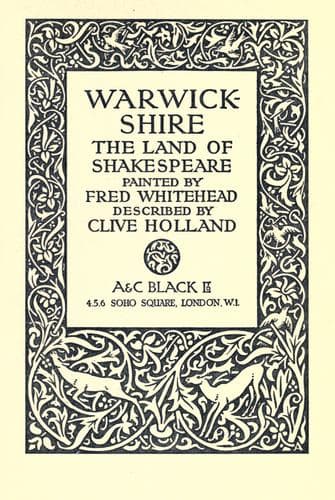
Warwickshire: The Land of ShakespeareHolland, Clive
History
Warwickshire: The Land of Shakespeare
Holland, Clive
Warwickshire (England) -- Description and travel
So far as Warwickshire’s part in the Civil War is concerned the most
stirring and memorable event after the battle of Edge Hill was the
attack upon and the destruction of a part of Birmingham by Prince
Rupert on Easter Monday of the year 1643.
Although many echoes of the struggle which was fiercely waged, and
with varying fortune to the contending parties, up and down the country
for a further period of two and a half years, reached Warwickshire, and
although several severe engagements were fought in the neighbouring
counties of Oxfordshire, Northamptonshire, and Berkshire, no very
considerable fighting took place in Warwickshire itself after the
burning of Birmingham. It was, however, so near the field of other
actions that its peace was perpetually disturbed during the succeeding
years, until the final crushing of the Royalist adherents at Naseby
on June 14, 1645, and the surrender of the King to the Scots in the
following year at Newark. Troops passed along its peaceful lanes on
many occasions, and manor–houses were raided by detached bodies of
Royalists and Parliamentarians, producing a feeling of unrest and
insecurity amongst the inhabitants, and imparting an element of romance
to many a time–worn building.
With the return of Charles II. in the early years of the Commonwealth,
and during the brief campaign succeeding his invasion of England to
assert his kingship, which ended so disastrously on “Cromwell’s day,”
September 3, 1651, at the battle of Worcester, Warwickshire once more
knew the presence of troops within its peaceful confines, and the
hurrying to and fro along its lanes and by–ways of fugitive Royalists
and armed pursuers.
After the battle Charles, whilst escaping in disguise, in company with
Miss Jane Lane, fled into Warwickshire, narrowly escaping capture by
some of the Lord Protector’s men near Bearley Cross. It was in the
kitchen of a house at Long Marston that the royal fugitive, to render
his disguise more effective, took his turn at the kitchen spit! And
Packington Old Hall also sheltered him and his companion during their
flight.
Warwickshire played no very prominent part in the history of the
half century immediately succeeding the Restoration, and although the
intervening years between the latter and the Napoleonic Wars saw many
changes, the life of the county was on the whole placid and uneventful.
Situated far inland, the wars of the closing years of the eighteenth
and early years of the nineteenth century made little impression on a
county then so agricultural in its interests and pursuits.
During the first quarter of the nineteenth century Warwick grew little,
though remaining the county town; and even the anciently renowned
city of Coventry had but an uneventful history, and progress chiefly
remarkable for its development of the ribbon industry.
Birmingham was as yet almost unthought of as a great industrial centre
of population.
Public-domain text, read in full here on John Shaqi.
Reviews
Reviews
No reviews yet
Be the first to share your thoughts on this work.
Join the Discussion
Join the discussion
Sign in to leave a comment or review.
Sign InorCreate an account