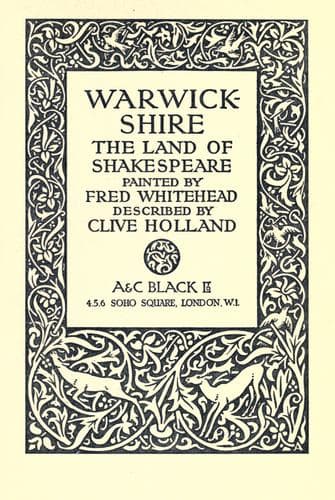
Warwickshire: The Land of ShakespeareHolland, Clive
History
Warwickshire: The Land of Shakespeare
Holland, Clive
Warwickshire (England) -- Description and travel
The political prominence of Birmingham, first earned in the reign of
Charles I., has continued of steady growth, although its “great fame
for hearty, wilful affected disloyalty” asserted by Clarendon happily
no longer abides with it.
Warwickshire, as we have stated, was in ancient times largely an
agricultural county, and, indeed, may still be reckoned so. Its
well–watered meads and pleasant valleys providing pasturage for cattle,
and its rich soil being productive of excellent crops.
The war, however, brought about a great change in the nature of its
industries. The men were in large numbers called off the land to supply
the needs of man power in the army; their places were taken by older
men who were above military age, by boys, women, and girls of all ranks
in society.
[Illustration: WARWICK CASTLE.]
The temporary growth in population of such towns as Coventry and
Birmingham was another noticeable effect of the necessities of war. On
the outskirts of the latter town temporary dwellings were erected in
large numbers to accommodate the munitions workers drawn to Birmingham
from all parts of the country, and in the case of the former town
enormous building operations were undertaken to provide factories and
to house the workers engaged in the same.
Coventry in war time was a very different place to the town of even the
period immediately preceding the outbreak of hostilities; and different
from the city of to–day which has gradually tended to return to the
normal.
The development of the munitions industries in the county formed one
of the most significant features of its life from the spring of 1915
to the autumn of 1918. Not only was the very face of the countryside
greatly altered in many districts, but the very lives of the people
underwent a radical though temporary change.
Unfortunately industrial unrest, which immediately followed the
armistice and extended into several of the succeeding years, prevented
Warwickshire from making full use of the enormously increased
facilities for output of manufactured articles for which the county
has long been famous. Even factories which only needed conversion in
comparatively unimportant details to fit them for the struggle to
capture the world–trade that waited to be won by enterprise and hard
work were left idle or were very imperfectly adapted to the needs of
peaceful production.
But that there is a great future for this county in the very heart of
England when industry has learned its lesson, and enterprise is once
more harnessed to the chariot wheels of commerce no one can doubt.
To–day Warwickshire has largely recovered from the temporary
dislocation of its life by war, and has returned to its more normal
occupations and mode of living.
Public-domain text, read in full here on John Shaqi.
Reviews
Reviews
No reviews yet
Be the first to share your thoughts on this work.
Join the Discussion
Join the discussion
Sign in to leave a comment or review.
Sign InorCreate an account