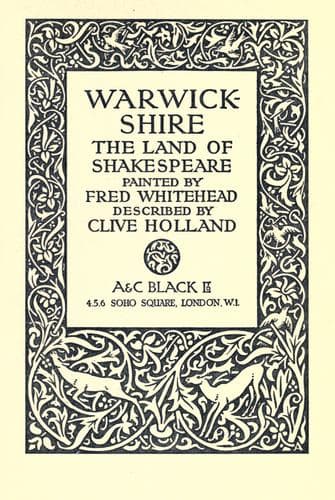
Warwickshire: The Land of Shakespeare — John Shaqi
Warwickshire: The Land of ShakespeareHolland, Clive
History
Warwickshire: The Land of Shakespeare
Holland, Clive
Warwickshire (England) -- Description and travel
Its war record, to be read in the gallant deeds of its fighting sons,
and in the amazing work performed by its women, girls, lads, and older
men, gives it a place of honour among the counties of central England,
as its natural loveliness has given it one of compelling charm among
the most beautiful.
CHAPTER III
FAYRE WARWICK TOWN: ITS HISTORY AND ROMANCE
The town of Warwick is undoubtedly of very ancient origin, and from the
earliest period of its existence has been considered the chief town of
the shire. It is situated upon a rocky plateau on the north side of the
river Avon, and blessed with a dry and fertile soil, with luxuriant
meadows on one side and well–wooded and well–cultivated lawns on the
other.
It seems not unlikely indeed that Gutherline or Kimberline, one of
the British kings who lived in the time of Christ, was the founder
of the first settlement at Warwick, and that Guiderius, the former’s
son, enlarged the town and bestowed upon it considerable privileges.
Originally, according to Rous, it was known as Cær–guthleon, contracted
into Cær–leon, derived from Cær, a fortress, and Guthline, the name of
its founder.
It was upon the site of an ancient church of All Saints founded by St.
Dubritius that the first castle was ultimately built; and about this
time that King Vortigern gave his ill–judged invitation to the Saxons,
who, arriving nominally to assist him against the Picts and Scots,
turned their swords against the nation to whose assistance they had
come.
St. Dubritius fled during these disorders to Wales for safety, and
abandoned Warwick, his cathedral, and his see to the mercy of the
invaders.
One ancient historian gives a vivid description of the rapine and
destruction to which the centre of England in general, and Warwick in
particular, was at that time subjected. And in his pages one sees the
surging hosts of Picts and Scots and Britons and Saxons contending for
the mastery of what was, even in those days, one of the most fertile
and desirable districts of all England.
Raided, burned, with many of the inhabitants put to the sword, Warwick
lay in ruins until the coming of King Warremund, the forbear of the
kings of Mercia, who rebuilt the town. Under his rule and that of his
descendants the town is stated to have flourished and grown in size and
importance until the coming of the Danes.
After some years, in which it once more lay in ruins, Warwick rose
phœnix–like from its ashes under the hand of Lady Æthelflæd, daughter
of King Alfred the Great and wife of King Æthelred. This princess in
the year 915 built the first castle and a fortification called the
Dungeon (donjon or keep?), and this building served as a residence of
the earls from that date for a century and a half, until the coming of
William the Conqueror.
Public-domain text, read in full here on John Shaqi.
Reviews
Reviews
No reviews yet
Be the first to share your thoughts on this work.
Join the Discussion
Join the discussion
Sign in to leave a comment or review.
Sign InorCreate an account