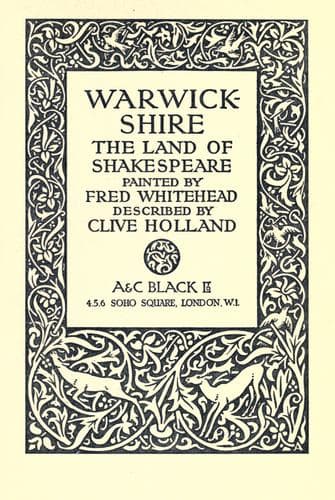
Warwickshire: The Land of Shakespeare — John Shaqi
Warwickshire: The Land of ShakespeareHolland, Clive
History
Warwickshire: The Land of Shakespeare
Holland, Clive
Warwickshire (England) -- Description and travel
A very interesting circumstance in connection with the Thomas de
Beauchamp we have just referred to, who had in 1351 a charter of free
warren at Warwick, is that he “at the suit of his lady, and for the
health of his own soul and his ancestors’ souls,” freed the traders
resorting hither for the future from terrage, stallage, and all other
sorts of toll. The petition having been made because the said traders
had been, by the heavy exactions of previous holders of the title,
driven away from the market at Warwick, to the great detriment of the
town.
The Municipal history of Warwick is unfortunately very obscure,
although there seems little or no doubt that the town was anciently
incorporated and had the privilege of returning members to Parliament,
but when it was first incorporated, and whether such incorporation
and privilege continued without interruption is not ascertainable. A
record, however, exists that there was a Mayor in 1279, in the reign
of Edward I., and that twenty–one years later the Mayor of the day and
bailiffs were ordered to allow Phillip de Rout and William de Serdely
reasonable expenses for their services as members of Parliament for
that year. Afterwards, however, in the reign of Edward III., the King’s
mandate for the same purpose was, strange to tell, addressed to the
bailiffs only.
The earliest known date of incorporation under royal charter with the
designation of bailiff and burgesses occurs in the reign of Philip and
Mary, but it is certain that letters patent were granted by Henry VIII.
in 1546 to the borough under the Municipal title of “burgesses only.”
This grant of letters patent was confirmed by one from James I. in
1613, and was again followed by another during the reign of William and
Mary, bearing the date of March 5, 1694, which remains the governing
charter of the borough down to the present time.
The history of the town of Warwick has, as we have remarked in a
previous chapter, been largely that of the county itself, and during
the ages when wars and revolts swayed parties in England the town
played its part in the romantic and tragic happenings of those times.
The old stone cross, which stood at the intersection of the two ancient
and principal streets as late as the reign of James I., has long
ago disappeared, but in few towns in England are there more notable
survivals of ancient times to be found than in Warwick. One of the most
interesting buildings is the ancient Chapel of St. James, now known as
the West Gate, and formerly as the Hongyn Gate, standing where the High
Street terminates, on the crest of the hill, supported for its entire
length by a lofty groined archway, itself placed on the bed–rock which
rises several feet above the road surface. This structure anciently
formed a defensive gateway to the old and fortified town.
Public-domain text, read in full here on John Shaqi.
Reviews
Reviews
No reviews yet
Be the first to share your thoughts on this work.
Join the Discussion
Join the discussion
Sign in to leave a comment or review.
Sign InorCreate an account