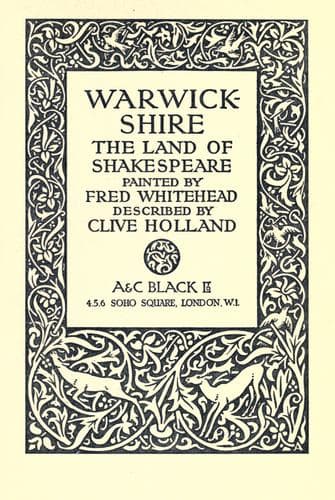
Warwickshire: The Land of ShakespeareHolland, Clive
History
Warwickshire: The Land of Shakespeare
Holland, Clive
Warwickshire (England) -- Description and travel
In the early years of William the Conqueror, Turchill, a Saxon, was
Earl of Warwick, a man of great power, possessions, and influence; and
he it was who was commanded by William the Conqueror to fortify the
town more strongly by means of walls and ditches, and to add to and
strengthen the existing castle.
A little later King William gave to his Norman favourite Henry de
Newburgh the title of Earl of Warwick and a grant of the castle, town,
and suburbs, to be held in _capite per Servitum Comitatus_. The new
Earl conferred upon one of his priests one–tenth of his tolls, as an
offering for the health of his soul. And Roger de Newburgh, his son,
who succeeded him, £4:10s. rent for a similar purpose to his priest.
In 1261, in the reign of Henry III., John de Plessetis, who had
married Margery, the last heiress of the De Newburghs, and thereby had
succeeded to the earldom, granted to the burgesses a charter to enable
them to hold each year a fair lasting three days, for which privilege
they paid no toll,—a concession of far more value and importance than
appears to the uninitiated.
The male branch of the De Newburghs failing, the family was succeeded
by that of Mauduit, and one of these, William, who was a supporter of
Henry III., was surprised and taken prisoner during the wars of the
barons, and, in consequence of the capture, the walls of Warwick Castle
were destroyed. He was also obliged to pay for the ransom of himself
and his Countess the then large sum of 1900 marks (about £1250). He
died childless, and was succeeded by his sister’s husband, William de
Beauchamp, who in the reign of Edward I. possessed the borough in chief
in 1279, and also held annually a fair, which lasted for sixteen days,
commencing on the eighth day before the Feast of St. Peter ad Vincula,
and a weekly market on Wednesdays.
A strange sidelight on these days is thrown by the record that there
was a pillory and tumbril as well as assize of bread in connection with
this fair. De Beauchamp also instituted a fifteen days’ fair, which
commenced on the eve of the Feast of St. Peter and Paul.
In the year 1290 William de Beauchamp’s successor, Guy, finding it
necessary to undertake considerable works for the walling in of the
town and the paving of its streets, was granted a patent by Edward
I. by which he was entitled to receive a toll during seven years on
all vendible articles. But the works not having been completed within
that period, he and his successor Thomas obtained an extension of the
original or similar patents for ten years longer.
Public-domain text, read in full here on John Shaqi.
Reviews
Reviews
No reviews yet
Be the first to share your thoughts on this work.
Join the Discussion
Join the discussion
Sign in to leave a comment or review.
Sign InorCreate an account