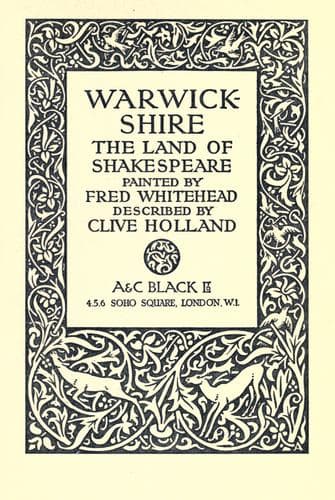
Warwickshire: The Land of ShakespeareHolland, Clive
History
Warwickshire: The Land of Shakespeare
Holland, Clive
Warwickshire (England) -- Description and travel
The garden contains a famous mulberry tree, almost old enough to
be historic, and in summer time the spot is gay with the bloom of
old–fashioned flowers. There is a charming vista of foliage and lawn
through a fine Norman circular–headed arch which, found during repairs
to the chapel, was erected in its present position some years ago. On
the eastern side of the garden is an open space, and the brethren’s
apartments are arranged on the south and west sides of the quadrangle.
On the right side of the latter is the famous old kitchen, in which
the brethren pass a great deal of their time on chilly days, smoking
and chatting, often fighting their battles o’er again, surrounded by
many historic relics, including a handsome black oak cabinet once in
Kenilworth Castle; an ancient Saxon chair; and another used by James I.
at the supper he took with Sir Fulke Greville.
One of the most interesting relics is the portion of a curtain from
Cumnor Hall, said to have been worked by ill–fated Amy Robsart. Amongst
the more martial are halberds and pistols of ancient date, the King of
Dahomey’s State execution sword, and some interesting copper tankards
dating some two hundred years back.
The great banqueting hall, in which Sir Fulke Greville in 1617
entertained James I., is on the western side of the quadrangle, but it
has fallen on evil times, and is now divided up into domestic offices.
The chapel in which the brethren worship is reached by a flight of
steps from the outer terrace, which runs in front of the almshouses at
an elevation above the street. The tower of the present interesting
building was in all probability erected by Thomas de Beauchamp about
the end of the fourteenth century, and on the embattled parapet are to
be seen his arms.
In 1863 the stability of the building gave some cause for anxiety,
and flying buttresses were added on the south side for the purpose
of strengthening it. Prior to that date the chapel was unfortunately
disfigured by several eighteenth–century additions, which were removed
and a thorough and well–advised restoration undertaken.
Dividing the chapel into almost equal portions is a finely–carved oak
screen, within which are the stalls of the brethren and officials. Near
the altar is an interesting piece of needlework of floral design, said
to have come from the hands of Amy Robsart.
Beneath the chapel is the gateway, similar to that on the eastern side
of the town, built on the sandstone rock and with strong vaulting,
which formed a part of the twelfth–century fortifications.
Public-domain text, read in full here on John Shaqi.
Reviews
Reviews
No reviews yet
Be the first to share your thoughts on this work.
Join the Discussion
Join the discussion
Sign in to leave a comment or review.
Sign InorCreate an account