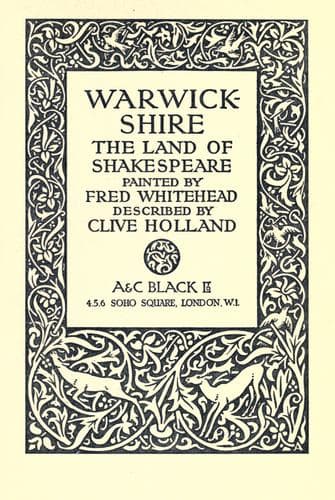
Warwickshire: The Land of ShakespeareHolland, Clive
History
Warwickshire: The Land of Shakespeare
Holland, Clive
Warwickshire (England) -- Description and travel
A little beyond Northgate Street, on a knoll, stands the Priory,
formerly dedicated to St. Sepulchre, and founded by Henry de Newburgh,
first Earl of Warwick, as a monastery for Canons Regular. At the
time of the Dissolution of Monasteries this ancient foundation was
granted to a trusted retainer of John Dudley, Earl of Northumberland,
Thomas Hawkins, whose father sold fish at the town Market Cross.
Unappreciative of either antiquity or the traditions of the building
into whose possession he had come, Hawkins, as might be anticipated,
pulled down the monastery and on the site of it erected the present
building, which was finished about 1565.
In this fine old Elizabethan mansion, with its many windows and
gables and air of ancient peace, is a lofty hall and a magnificent
old oak staircase and oak–panelled dining–room. The south front is
comparatively modern, as it was rebuilt about the middle of the
eighteenth century; but the north front still preserves many of its
original features.
One of the most interesting incidents connected with the house was the
surprise visit paid by Queen Elizabeth on August 17, 1572, who, coming
over from Kenilworth unexpectedly, found the Earl and Countess of
Warwick at supper, and sat down to the meal with them. The owner of the
house was confined to his bed; but the Queen, who, if tradition may be
believed, was less austere than historians would have us infer, setting
aside ceremony, visited “the good man of the house, who at that time
was grievously vexed with the gout.”
The first owner of the Priory, by means of grants and judicious
purchases, managed to accumulate a large amount of property, which, in
less than four years from the date of his death—occurring in 1576—his
son Edward had squandered, even to the selling of his home to Sergeant
Puckering, then Lord Keeper of the Great Seal, whom he sought to cheat
by means of a fraudulent conveyance. Hawkins was prosecuted in the Star
Chamber, and eventually ended his days in the Fleet Prison.
The Priory remained in the possession of the Puckering family until the
beginning of the eighteenth century, when it became the property of a
Mr. Henry Wise, a superintendent of the Royal Gardens at Hampton Court.
Although this fine survival of domestic architecture of Elizabethan
times was of necessity acquired by the Great Western Railway Company
in the middle of the last century, in connection with the extension
of their line to Birmingham, it fortunately escaped destruction, and
was eventually sold by the Company to Mr. Thomas Lloyd, a banker of
Birmingham.
At the foot of Smith Street, which runs down from the East Gate, stands
the fine old house known as St. John’s Hospital, founded in the reign
of Henry II. by William de Newburgh, Earl of Warwick, as a hospital in
aid of the poor, and for relief and reception of strangers.
Public-domain text, read in full here on John Shaqi.
Reviews
Reviews
No reviews yet
Be the first to share your thoughts on this work.
Join the Discussion
Join the discussion
Sign in to leave a comment or review.
Sign InorCreate an account